
A scenic spot in Western Pomerania, Trzesacz is visited by crowds of people every year. A lot of them are summer holidaymakers enjoying the sea and the sandy beaches, while others come here to see the remains of the Gothic church of St. Nicolas, erected in the 15th century and the ruins of which are the postcard symbol of Trzesacz. This part of the coastline is a spectacular example of the erosive power of the waves, and visiting the ruins picturesquely located on the cliff gives you a clear idea of just how mighty the sea is.
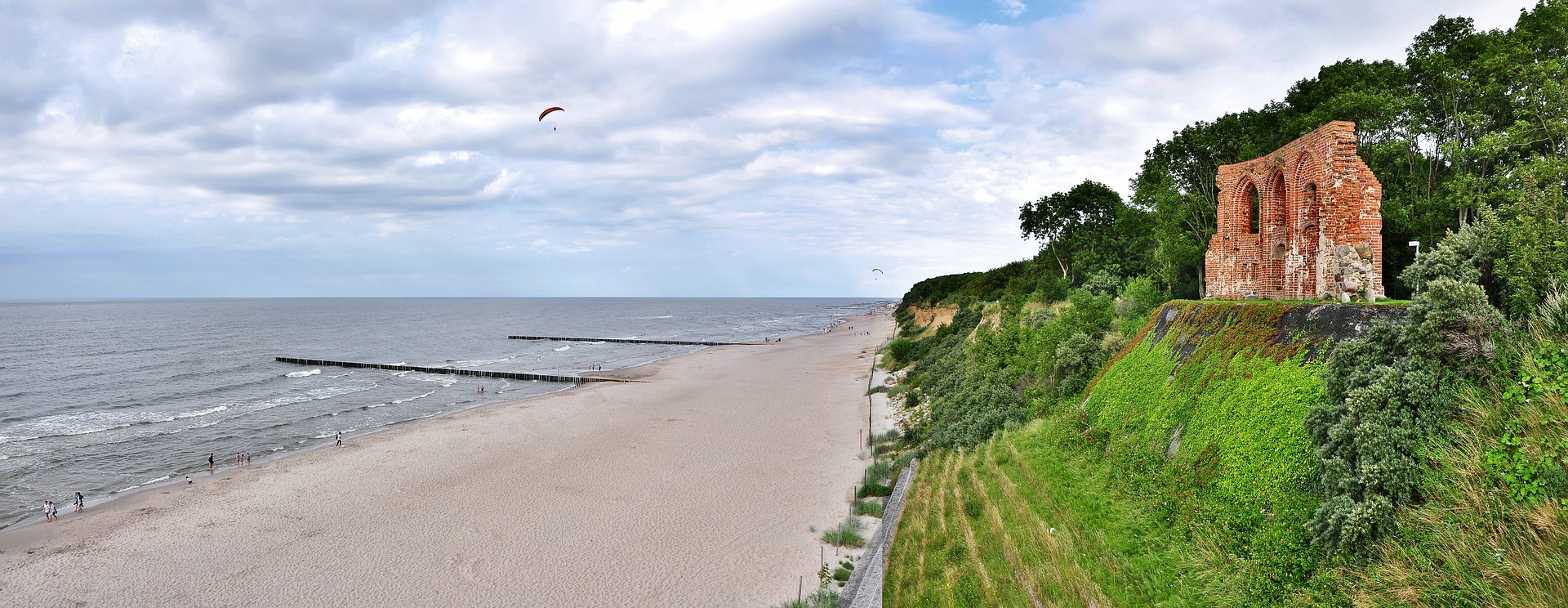
The church in Trzesacz was originally erected 2 km away from the sea; however, during the course of time the sea has eroded and devoured the land. In the 19th century a decision was taken to close the church for safety reasons, and the first wall fell in 1901 with the next soon after. The final collapse took place in 1994 and at present all that remains is just one brick wall standing alone on a sandy cliff covered with concrete for protection against the powerful waves. Nevertheless, predictions say that before long nothing will be left of the church: after over 100 years it will certainly succumb to the destructive power of the sea. Nevertheless, today the ruins continue to draw tourists and are a much-photographed site.
In summer you can get to Trzesacz from the town of Gryfice on board a train on the old narrow-gauge railway. A stay in the village at this time of the year gives you the opportunity for plenty of water sports and especially for paragliding from the take-off point on one of the cliffs. The local 19th century palace nowadays houses a hotel and horse stables.
Trzesacz is on the Rewal Seashore in Western Pomerania, some 60 km east of Miedzyzdroje, 40 km from Kolobrzeg, 20 km from Kamien Pomorski and 10 km from Trzebiatow. The ruins of the church are situated on a near-vertical cliff rising a total of 15 m above the sea.
The region of Trzesacz enjoys a favourable sea climate. Here both summers and winters are short, the latter are in fact the mildest in the country and the average annual temperature is 7-7.5 degrees C.
Once upon a time, as the legend goes, local fishermen pulled Zielenica, the daughter of the god of the Baltic, out of the sea. The priest wanted to convert the girl, but she died a captive and was buried in the cemetery. Her father, determined to take his daughter’s body, is seizing the land gradually, piece by piece.
What we do know for a fact is that at one period there was a relatively rich parish village close to the shore, and the oldest mention of a church of St. Nicolas comes from 1313.
In the second half of the 15th century, Prince Boguslaw X divided Trzesacz, together with the surrounding countryside, between two knight’s families – the Flemings and the Knuths. However, by the beginning of the 16th century all these lands had come into the hands of the Fleming family. During the 18th century and onwards, Trzesacz and the neighbouring area often changed hands. The last owners, who held the lands until the outbreak of World War II, were the Kollers.
In the 1870s the sea was so close to the old church that it was closed and a new Neo-Gothic church was erected in the centre of the village, near the park. Up until 1918 the owners of Trzesacz gained some of their income from the shore privilege that they had long enjoyed and which was usually granted to kings.
In 1939 the lands covered an area of 452 hectares and were worth 322 German marks. The Neo-Gothic church in Trzesacz was destroyed in March of 1945 during military operations.
| Province: | Western-Pomeranian |
| Telephone: | +48 89 |
| Accommodation: | Trzesacz hotels |