
Pope John Paul II Tour: A Soulful Sojourn in Poland’s Sacred Spaces
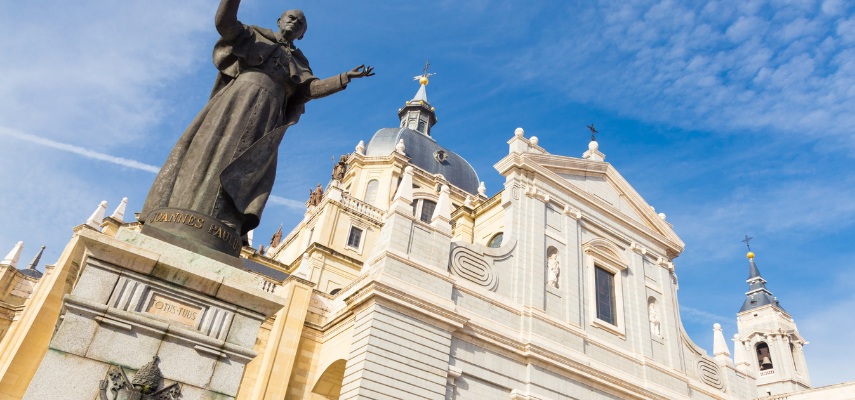
Karol Wojtyła lived in southern Poland for 58 years before he became Pope. The apartment in Wadowice where he was born, the Kraków churches where he was ordained and consecrated, the sanctuary in Łagiewniki he championed — they’re all still there, most of them within an hour’s drive of each other. This guide covers every major stop on the John Paul II pilgrimage trail, with verified facts, practical logistics, and the stories of the people whose paths crossed his.
At a Glance
- Wadowice — Wojtyła’s birthplace, now a modern multimedia museum at 7 Kościelna Street. He lived here from 1920 to 1938.
- Kraków — where he was ordained a priest (1946), consecrated as bishop (1958), and served as archbishop until his election as Pope in 1978. Key sites: the Archbishop’s Palace at 3 Franciszkańska Street, St. Florian’s Basilica, and the Wawel Cathedral.
- Sanctuary of Divine Mercy, Łagiewniki — the center of the global Divine Mercy devotion, tied to both St. Faustina Kowalska and John Paul II. He consecrated the new basilica here in 2002.
- Kalwaria Zebrzydowska — a 17th-century pilgrimage park with 42 chapels, inscribed on the UNESCO World Heritage List in 1999. Wojtyła walked these paths from boyhood.
- Jasna Góra, Częstochowa — Poland’s national shrine, home to the Black Madonna icon, drawing over 4 million pilgrims a year.
- Warsaw — site of Wojtyła’s first papal pilgrimage to Poland (1979) and the grave of Blessed Jerzy Popiełuszko, the Solidarity chaplain murdered in 1984.
- Most sites are within 50–130 km of Kraków. A focused tour covers the core trail in 4–6 days.
Wadowice: Where It Started
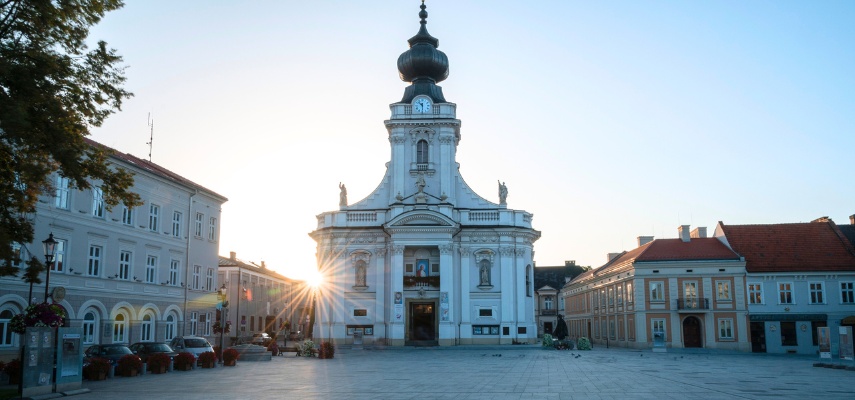
Karol Józef Wojtyła was born on May 18, 1920, in a modest first-floor apartment at 7 Kościelna Street in Wadowice, a town of about 20,000 people roughly 50 km southwest of Kraków. His family — father Karol Sr., mother Emilia, and older brother Edmund — rented two rooms and a kitchen from Chaim Bałamuth, a Jewish merchant who ran a hardware store on the ground floor. The Wojtyła and Bałamuth families lived under the same roof; young Karol grew up in a town where Poles and Jews shared schools, streets, and daily life. About 20% of interwar Wadowice was Jewish.
Tragedy came early. Emilia died in 1929, when Karol was nine. Edmund, who had become a doctor, died of scarlet fever in 1932 at age 26 — contracted from a patient he was treating. Father and son lived alone in one room and the kitchen for the next six years, until they moved to Kraków in 1938 so Karol could study Polish philology at Jagiellonian University.
The Museum of the Holy Father John Paul II Family Home now fills the entire building. Renovated between 2010 and 2014, it spans four floors and 1,200 square meters across 16 exhibition zones. The heart of the museum remains the Wojtyła family apartment, furnished with period items and original family possessions. The rest of the building uses multimedia installations — holograms, 3D projections, touchscreens, and audio recordings — to trace Wojtyła’s life from Wadowice through the papacy.
Visits are guided (available in Polish, English, German, Italian, Spanish, French, Portuguese, and Russian) and last about 70 minutes. Groups are capped at 25 people.
Practical details:
- Address: ul. Kościelna 7, 34-100 Wadowice
- Tickets: 30 PLN (standard), 23 PLN (reduced); guided tours 45/38 PLN
- Free admission on Tuesdays
- Closed the last Tuesday of each month (technical day)
- Booking recommended: domjp2.pl
- No on-site parking; use street parking or town center lots
Across the street stands the Basilica of the Presentation of the Blessed Virgin Mary, the parish church where Wojtyła was baptized on June 20, 1920. The baptismal font is still there. From the kitchen window of the family apartment, Karol could see the sundial on the church wall with the inscription “Time is running, eternity is waiting.” Visitors can still see it today.
Before you leave Wadowice, get a kremówka — the cream-filled pastry that was Wojtyła’s childhood favorite. Every bakery around the main square sells its own version. It’s not a tourist gimmick; locals eat them too.
Kraków: The City That Shaped a Pope
Wojtyła arrived in Kraków in 1938, an 18-year-old enrolling at Jagiellonian University. He would spend the next 40 years here — as student, clandestine seminarian, priest, professor, bishop, archbishop, and cardinal — before leaving for Rome in October 1978.
The War Years and the Underground Seminary
When Nazi Germany occupied Poland and shut down the university in 1939, Wojtyła worked first in a quarry and then at the Solvay chemical factory to avoid deportation. Feeling called to the priesthood, he began studying secretly in 1942 in a clandestine seminary organized by Archbishop Adam Stefan Sapieha, one of Kraków’s most courageous wartime figures. Sapieha sheltered seminarians in his residence, sent appeals on behalf of arrested professors and Jewish community leaders, and helped organize false baptismal certificates for Jews.
Wojtyła was ordained a priest on November 1, 1946, in the private chapel of the Archbishop’s Palace at 3 Franciszkańska Street. That building — a short walk from the Main Market Square — would later become his own residence as Archbishop of Kraków. The famous “papal window” on the first floor, where he addressed crowds both as archbishop and later during papal visits, faces the street. It remains a gathering point for pilgrims.
Key Kraków Sites
Archbishop’s Palace, 3 Franciszkańska Street — Wojtyła’s home as Archbishop (1964–1978). The papal window above the main entrance became iconic during his visits to Kraków as Pope.
St. Florian’s Basilica — Where the young Father Wojtyła served as a curate and university chaplain in the early 1950s.
Wawel Cathedral — The seat of Kraków’s bishops for centuries. Wojtyła celebrated Mass here as Archbishop and returned as Pope.
The Church of St. Francis of Assisi (Franciszkańska Street) — Adjacent to the Archbishop’s Palace, with remarkable Art Nouveau stained glass by Stanisław Wyspiański.
Nowa Huta — The communist-planned “model workers’ town” on the outskirts of Kraków, built without a church. Wojtyła began celebrating open-air Christmas Midnight Mass here in 1959, and spent years pressuring the communist authorities to allow a church to be built. The Ark of the Lord Church (Arka Pana), finally dedicated in 1977, stands as a monument to that struggle.
Sanctuary of Divine Mercy, Łagiewniki
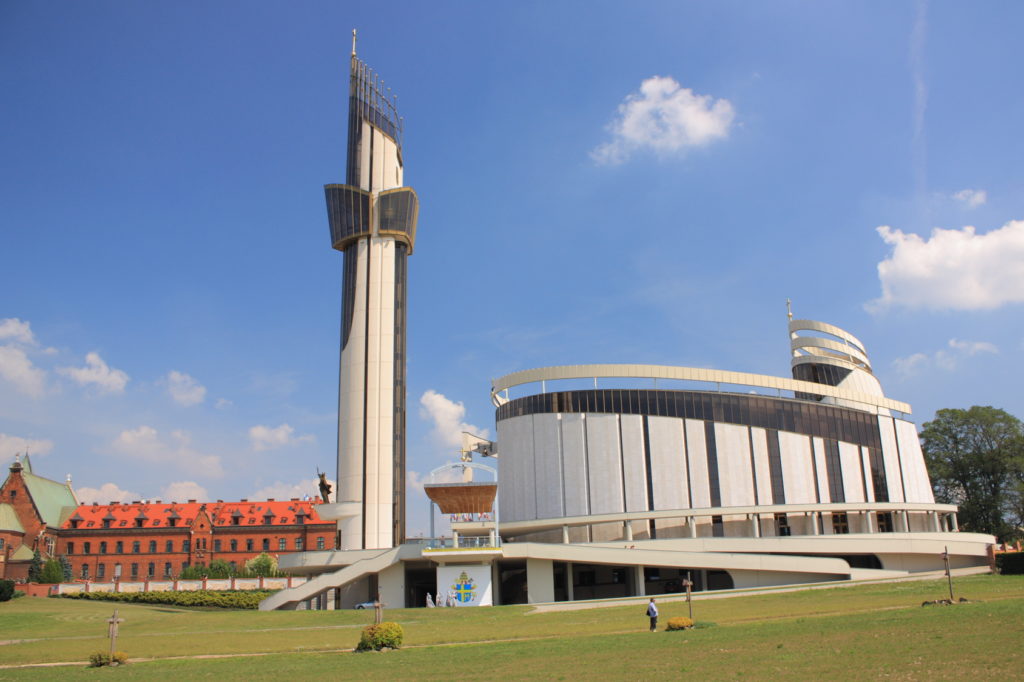
The Sanctuary of Divine Mercy in Kraków’s Łagiewniki district is one of the most visited pilgrimage sites in Poland, drawing around two million visitors a year. Its story intertwines two saints: Faustina Kowalska and John Paul II.
Saint Faustina Kowalska (1905–1938)
Helena Kowalska was born on August 25, 1905, in Głogowiec, a village northwest of Łódź — not in Łódź itself. She was the third of ten children in a poor farming family. At 19, while working as a housekeeper in Łódź, she had a vision of a suffering Jesus at a dance. She went to the nearest church — the Cathedral of St. Stanisław Kostka in Łódź — and received what she described as an instruction to go to Warsaw and enter a convent. She joined the Congregation of the Sisters of Our Lady of Mercy in Warsaw in 1925.
Her major visions occurred not in Łódź but in Płock (1931), where she said Jesus appeared and asked her to have an image painted of him as the King of Divine Mercy, and in Vilnius, where her confessor Father Michał Sopoćko helped commission the first Divine Mercy painting (by artist Eugeniusz Kazimierowski). She took her final vows at the Łagiewniki convent in 1933, and died of tuberculosis at age 33 in Kraków on October 5, 1938.
Her diary, published as Divine Mercy in My Soul, runs to nearly 700 pages and records her reported visions, prayers, and conversations with Jesus. The Vatican initially banned the diary in 1959 due to a flawed translation. As Archbishop of Kraków, Karol Wojtyła had the diary properly re-translated and lobbied for the ban’s removal, which came in April 1978 — six months before his election as Pope. He beatified Faustina in 1993 and canonized her in 2000.
What to See at Łagiewniki
St. Joseph’s Chapel (the old convent chapel) — Houses St. Faustina’s tomb and the famous Divine Mercy image painted by Adolf Hyła in 1943–44. Every day at 3:00 PM, pilgrims pray the Chaplet of Divine Mercy here in multiple languages.
The Basilica of Divine Mercy — The modern basilica, designed by architect Witold Cęckiewicz, was consecrated by John Paul II on August 17, 2002, during his last pilgrimage to Poland. Its ellipsoidal shape is meant to evoke a ship. The building accommodates about 5,000 people and has a 77-meter observation tower with panoramic views of Kraków.
The “Have No Fear!” John Paul II Centre — A short walk from the basilica, located on the site of the former Solvay quarry where the young Wojtyła once worked. It includes a church with papal relics (including the blood-stained cassock from the 1981 assassination attempt), a museum of John Paul II’s life, and an exhibit on the Shroud of Turin.
Getting there: Łagiewniki is well connected to central Kraków by tram (line 8, among others) and bus. The ride takes about 20–30 minutes from the city center.
Kalwaria Zebrzydowska: The Polish Jerusalem
Kalwaria Zebrzydowska sits about 14 km east of Wadowice in the foothills of the Beskid Makowski mountains. Founded in 1600 by Mikołaj Zebrzydowski, the Voivode (governor) of Kraków, it was designed as a replica of Jerusalem’s sacred topography — a safer and cheaper pilgrimage alternative for Polish Catholics who couldn’t make the dangerous journey to the Holy Land.
Between 1605 and 1632, forty-two chapels and churches were built across the surrounding hills, their names echoing biblical geography: the Mount of Olives, Golgotha, the Cedron Valley. The chapels are connected by roughly 5 km of Calvarian paths. The Baroque Basilica of Our Lady of the Angels and the Bernardine Monastery form the sanctuary’s core. The complex was inscribed on the UNESCO World Heritage List in 1999 — the only Calvary in the world to receive that recognition.
Karol Wojtyła visited Kalwaria from boyhood. As a young priest and later as Archbishop, he returned regularly to walk the Stations of the Cross alone. As Pope, he visited in 1979 and 2002. Kalwaria Zebrzydowska is Poland’s second most important pilgrimage site after Jasna Góra, welcoming over one million visitors a year.
What to know before visiting:
- The Calvarian paths are physically demanding — steep, uneven terrain over about 5 km. Sturdy shoes and water are essential.
- The annual Holy Week mystery plays (Mysteries of the Passion) draw the largest crowds.
- The Feast of the Assumption of the Virgin Mary (August 15) is the other peak pilgrimage period.
- From Kraków: about 1 hour by car or bus.
Jasna Góra, Częstochowa: Poland’s Spiritual Capital

Jasna Góra (“Luminous Mountain”) in Częstochowa, roughly 130 km north of Kraków, is Poland’s national shrine and one of the world’s major Catholic pilgrimage sites. The Pauline monastery, founded in 1382, houses the icon of the Black Madonna of Częstochowa — a painting of the Virgin Mary with the Christ Child, attributed with miraculous powers and bearing distinctive scars from a 1430 Hussite attack.
The monastery draws over 4 million pilgrims a year from about 80 countries. The annual walking pilgrimages from various Polish cities are a national tradition; the Warsaw pilgrimage covers about 250 km over 9 days.
John Paul II visited Jasna Góra multiple times, both as Cardinal and as Pope. It was central to his vision of Polish Catholic identity.
Visitor tips:
- Upon entering the monastery, silence is expected.
- Long queues to approach the Black Madonna shrine are common; pilgrims traditionally traverse the final stretch on their knees.
- The monastery treasury contains centuries of votive offerings and historical artifacts.
- Częstochowa is about 2–2.5 hours by car from Kraków, or accessible by train.
Warsaw: The First Pilgrimage and the Solidarity Martyr
Warsaw’s role in the John Paul II story is primarily tied to his first papal pilgrimage to Poland in June 1979 — a nine-day visit that drew millions and is widely credited with helping ignite the Solidarity movement. His open-air Mass in Warsaw’s Victory Square (now Piłsudski Square), where he spoke the words “Let your Spirit descend and renew the face of the earth — of this earth,” became one of the defining moments of the 20th century.
Blessed Jerzy Popiełuszko (1947–1984)
Warsaw is also the resting place of Father Jerzy Popiełuszko, the Solidarity chaplain who became a symbol of peaceful resistance to communism. Popiełuszko, ordained in 1972, served in Warsaw parishes and became the unofficial chaplain of the Solidarity trade union after joining striking workers at the Warsaw Steelworks in 1981. His monthly “Masses for the Homeland” at St. Stanislaus Kostka Church in the Żoliborz district attracted thousands and were broadcast by Radio Free Europe.
On October 19, 1984, Popiełuszko was kidnapped by three agents of the communist Security Service while returning from a pastoral visit to Bydgoszcz. He was beaten, bound, weighted with stones, and thrown into the Vistula River. His body was recovered on October 30. An estimated 250,000 to one million people attended his funeral on November 3, 1984. He was beatified in 2010.
His grave at St. Stanislaus Kostka Church remains an active pilgrimage site. The church is in the Żoliborz district, accessible by public transport from central Warsaw.
Other Saints on the Polish Pilgrimage Trail
Saint Maximilian Kolbe (1894–1941)
Maximilian Kolbe was a Polish Franciscan friar, priest, and missionary. He founded Niepokalanów, a large friary and publishing operation near Warsaw, and ran a Catholic newspaper with a circulation of 800,000.
Arrested during the German occupation, he was sent to Auschwitz in May 1941. At the end of July 1941, when three prisoners went missing from his block, the camp’s deputy commander selected ten men to die by starvation as collective punishment. One of the selected men, Franciszek Gajowniczek, cried out for his wife and children. Kolbe stepped forward and volunteered to take his place.
Kolbe was locked in the starvation bunker of Block 11. After two weeks without food or water, he was one of four men still alive. On August 14, 1941, the remaining prisoners were killed with injections of phenol. Kolbe was 47.
Gajowniczek survived the war and attended Kolbe’s canonization by John Paul II on October 10, 1982. Kolbe was declared a “martyr of charity.”
Kolbe’s story is told at the Auschwitz-Birkenau Memorial, where Cell 18 of Block 11 — the starvation bunker — is preserved. Auschwitz is in Oświęcim, about 60 km west of Kraków.
Planning a John Paul II Pilgrimage
Who Is This Trail For?
This pilgrimage appeals to Catholic pilgrims and travelers interested in 20th-century history, Polish culture, and the intersection of faith and politics in Central Europe. You don’t need to be Catholic to find value here — the sites tell a story about resistance, identity, and how individuals shaped the course of history.
How Long Do You Need?
| Duration | What You Can Cover |
|---|---|
| 2–3 days | Kraków + Łagiewniki + Wadowice + Kalwaria Zebrzydowska |
| 4–5 days | Add Częstochowa (Jasna Góra) and Auschwitz |
| 6–7 days | Full trail including Warsaw (Popiełuszko’s grave, papal pilgrimage sites) |
Best Time to Visit
- May–September offers the best weather for walking the Calvarian paths at Kalwaria Zebrzydowska and attending open-air events.
- Holy Week (March/April) and the Feast of the Assumption (August 15) bring the biggest pilgrimage crowds to Kalwaria Zebrzydowska.
- Divine Mercy Sunday (first Sunday after Easter) is the peak day at Łagiewniki — expect very large crowds.
- October 22 (Feast of St. John Paul II) sees special observances at sites across the trail.
Getting Around
Kraków is the natural base. Wadowice, Kalwaria Zebrzydowska, Łagiewniki, and Auschwitz are all within 60 km. Częstochowa is about 130 km north. Warsaw is roughly 300 km and best reached by train (2.5 hours on the express) or domestic flight.
Organized pilgrimage tours from Kraków typically run 1-day (Wadowice + Kalwaria Zebrzydowska or Łagiewniki) or multi-day (6–7 days covering the full trail including Warsaw and Częstochowa). StayPoland offers a 6-day semi-guided Route of John Paul II starting from Warsaw.
EXPLORE PILGRIMAGE TOURS

The Route of John Paul II
Min. 2 pax- Poland’s best pilgrimage trail
- places dedicated to Karol Wojtyla
- enchanting sanctuaries in Kalwaria Zebrzydowska (UNESCO) and Lagiewniki

Following Saint Faustina
- St. Faustina’s birthplace
- Black Madonna of Częstochowa
- Sanctuary of the Divine Mercy


User Comments (0)