
Poznań Travel Guide: What to See in a Weekend
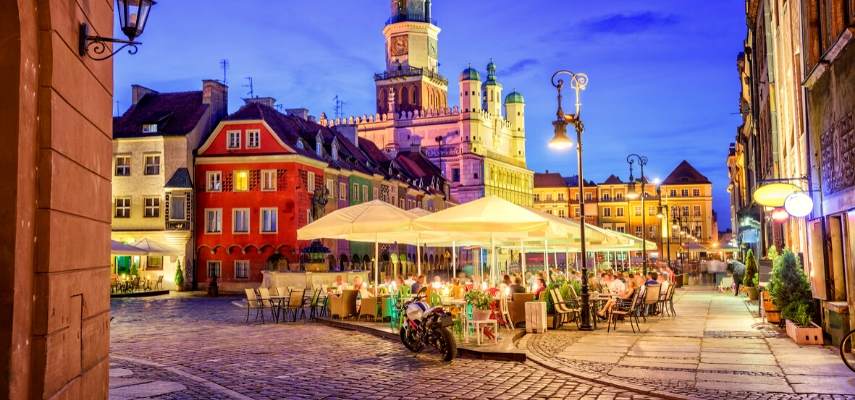
Poznań is one of the places where Poland began — a cathedral island, an old merchant city, and Greater Poland’s modern commercial centre, with food and architecture that reward the kind of traveller who has already done Warsaw and Kraków. Two days cover the centre at a relaxed pace. A third opens up a regional day trip — coronation cathedral, castle library, or a working steam depot, depending on which suits you.
At a Glance
- Where: Greater Poland (Wielkopolska), western Poland — roughly 300 km from Warsaw and 270 km from Berlin
- Why come: Burial place of Poland’s first rulers, home of an EU-protected pastry tradition, the home ground of Lech Poznań, and one of the most architecturally varied old cities in the country
- How long: Two to three days for the centre; add a fourth for one day trip
- Best time: Late spring through early autumn for outdoor cafés on Stary Rynek; November 11 for the St. Martin’s Day croissant festival
- Getting in: Direct trains from Berlin (around three hours) and Warsaw (around two hours forty); Ławica Airport is 7 km west of the centre, bus 159 reaches the main station in 20–25 minutes
- Don’t miss: The mechanical goats above the Town Hall (noon, and currently also 3 PM), the tombs of the first Piast rulers at the cathedral, a certified St. Martin’s croissant, the mural in Śródka
- Local tip: The Poznań City Card includes free public transport and entry to most municipal museums — useful if you plan more than two paid attractions a day
The most efficient weekend in Poznań takes in the Old Market Square and the Town Hall goats, Ostrów Tumski with its cathedral and Brama Poznania, a certified St. Martin’s croissant from a Stary Rynek bakery, the Imperial Quarter and Enigma Cipher Centre, and one longer excursion — Gniezno, Kórnik, or Wolsztyn — if you have a third day.
How to spend a weekend in Poznań
- Day 1 — Old Town and Stary Rynek. Start on the Old Market Square, time the Town Hall goats at noon if your morning allows, visit the Croissant Museum and pick up a certified rogal świętomarciński from a Stary Rynek bakery, then walk into the Museum of Musical Instruments or the Museum of the History of Poznań inside the Town Hall. Dinner on or near the square.
- Day 2 — Ostrów Tumski and the cathedral. Cross the Warta to Cathedral Island. Start with Brama Poznania to set the historical frame, then the cathedral with the Golden Chapel and the crypt. Walk on to the Śródka district immediately east for lunch and the celebrated three-dimensional mural. In the afternoon, take a tram west to the Imperial Quarter for the Enigma Cipher Centre and the Zamek Cultural Centre.
- Day 3 (optional) — one day trip. Choose one rather than rushing all three: Gniezno for early Polish history, Kórnik for castle-and-library culture, Wolsztyn for the working steam railway. Each takes a full day with public transport.
Why Poznań
Poznań is one of Poland’s oldest cities, and one of the clearest places to see the country’s early Piast history in a single morning. The first defensive stronghold on Ostrów Tumski — the cathedral island — dates to the early medieval period. By 966, when Duke Mieszko I accepted Christianity and brought his territory into the Latin Christian world, Poznań was already one of the leading political centres of the early Piast realm.
It is also where Poland’s first rulers are buried. Mieszko I, his son Bolesław Chrobry — crowned the first King of Poland in 1025 — and several of their successors lie in the cathedral on Ostrów Tumski. Few places in Poland concentrate the early Piast story so tightly.
Poznań has been a city of exchange for most of its history. The Poznań International Fair, operating since 1921, remains Poland’s largest trade-fair organisation and venue, drawing tens of thousands of business visitors a year; the Michelin Guide now lists sixteen restaurants in and around the city. That business traffic has also left Poznań with unusually strong hotels and rail connections for a city many leisure travellers still underestimate. Walk west from Stary Rynek and the streets open into broad nineteenth-century avenues, a large semicircular plac Wolności, and regular orderly blocks that feel cooler and more planned than the older Polish capitals — a second layer of the city that sits comfortably alongside the medieval core.
For travellers who have already seen Warsaw and Kraków, Poznań is a strong third Polish city to add: smaller, less crowded, and older as a political centre than either.
The Old Market Square and the Goats at Noon
Stary Rynek, the Old Market Square, is the third-largest market square in Poland after Kraków and Wrocław, and where most Poznań visits begin. Laid out in 1253 when the city received its town charter, the square measures 141 metres on each side and is ringed by merchant houses in pink, ochre, blue and green — colours restored after wartime destruction, though the square is more interesting than its façades suggest at first.
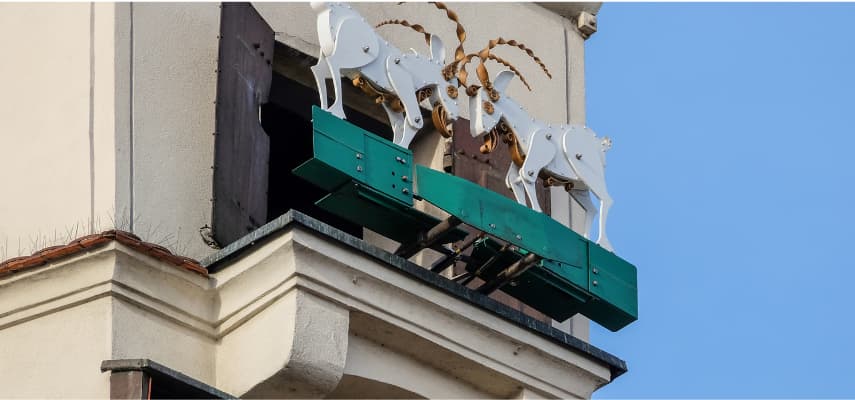
The Renaissance Town Hall gives the square its centre of gravity. Designed by the Italian architect Giovanni Battista di Quadro and completed in 1560, it is one of the most important Renaissance buildings in Poland. The east-facing facade carries a clock tower with a small pair of mechanical doors. Every day at 12:00 — and, according to current Visit Poznań information, also at 15:00 — the doors open and two metal billy goats appear and butt heads twelve times. The ritual lasts only a few minutes; arrive ten minutes early for a clear view, then move on.
Inside the Town Hall is a branch of the Museum of the History of Poznań, with restored ceremonial halls and a basement section showing the city’s medieval foundations. Around the square you will also find the Croissant Museum, the Museum of Musical Instruments, and the start of the Royal-Imperial Route — a walking trail that connects the major historical sites of the city. Restaurants on the square itself are pleasant on a warm evening but tend toward middling quality; for a better meal, walk one or two streets in.
Ostrów Tumski and the Burial Place of Poland’s First Kings
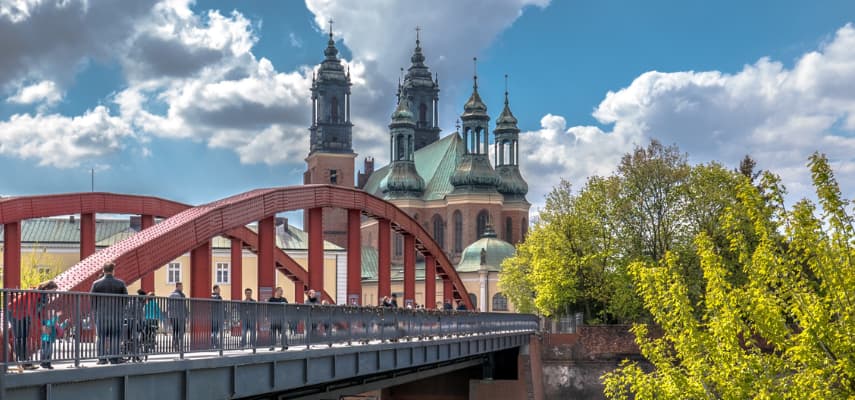
A twenty-minute walk east of the Old Town across the Warta River brings you to Ostrów Tumski, the cathedral island. This is the oldest inhabited part of Poznań and the place where Poland’s history as a Christian state effectively began. Unlike Kraków’s Wawel, Ostrów Tumski is not a hilltop royal complex; it is a compact, low-rise origin site where archaeology, myth and state formation overlap in a few hundred square metres.
The Cathedral Basilica of St. Peter and St. Paul stands on the site of the first cathedral in Poland, established in 968 when Bishop Jordan arrived as the country’s first missionary bishop. The present Gothic structure dates mostly to the fourteenth century, with Baroque alterations and a careful postwar reconstruction. In the crypt beneath the building, archaeologists have uncovered the foundations of a tenth-century baptistery, often associated with the Christianisation of Mieszko I’s realm.
The cathedral’s Golden Chapel, behind the main altar, marks the traditional burial place of Mieszko I and Bolesław Chrobry. The chapel itself is a nineteenth-century Neo-Byzantine setting. For anyone interested in Polish history, this is one of the rooms in the country that pays back close attention.
Across the square from the cathedral is Brama Poznania (Porta Posnania), an interactive heritage centre opened in 2014 that uses multimedia exhibits to walk visitors through a thousand years of Polish history. It works best as preparation for the cathedral — visit first, then cross the square. Audio guides are available in English.
Immediately east of Ostrów Tumski, across a short bridge, is the Śródka district — a separate small town until 1800 and now one of Poznań’s quieter neighbourhoods. The main draw is the large three-dimensional mural on the corner of the Śródka market square (“Śródka Tale with Trumpeter on the Roof and Cat in the Background”, 2015), but the area is also where the better lunch options on this side of the river are concentrated. Plan an hour here.
The whole cathedral island plus Śródka can be covered in half a day.
The St. Martin’s Croissant and Its Museum
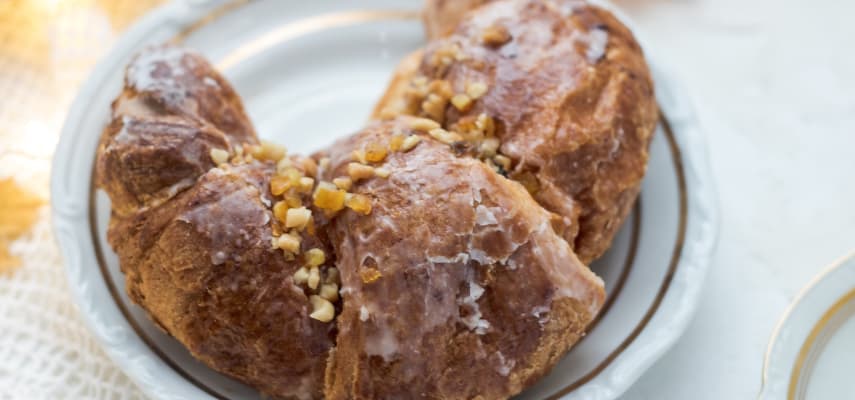
The rogal świętomarciński — St. Martin’s croissant — is Poznań’s most distinctive food and a piece of EU-recognised cultural heritage. In 2008 the European Union added it to its register of Protected Geographical Indications, placing it within the same family of EU food protections as Champagne, Parmigiano-Reggiano and Parma ham. Only bakeries certified by the Poznań Chapter of Bakers and Confectioners, using a specific recipe of semi-puff yeast pastry and white poppy seed filling, can sell pastries under the official name.
The tradition is linked to the parish of St. Martin in central Poznań and the saint’s feast day on November 11 — which is also Polish Independence Day. The modern form of the tradition is usually dated to 1891, when the parish priest Father Jan Lewicki asked bakers to make pastries for the poor in imitation of Saint Martin’s act of cutting his cloak in half. Around November 11, production rises sharply; Visit Poznań notes that as many as a million croissants may be eaten during the celebrations.
A certified croissant is large, dense and sweet — a quarter-pound of pastry filled with poppy-seed paste, candied fruit and nuts, glazed and finished with chopped almonds. One is enough; two is too many.
The Poznań Croissant Museum on Stary Rynek isn’t a museum in the traditional sense — it’s a live demonstration of the baking process. The guide kneads dough, explains the recipe, folds in enough Poznań dialect to make the demonstration feel local rather than theme-park generic, and ends by handing out warm samples. English-language sessions are offered regularly; check the current timetable before booking, especially in summer when the room fills quickly.
For a certified croissant outside the museum, look for the official PGI sticker in bakery windows. Cukiernia Kandulski has multiple branches and is one of the longest-running certified producers; Cukiernia Sowa is another widely available certified bakery.
Beyond the Old Town: Imperial Castle, Stary Browar, Malta Lake, Music Museum
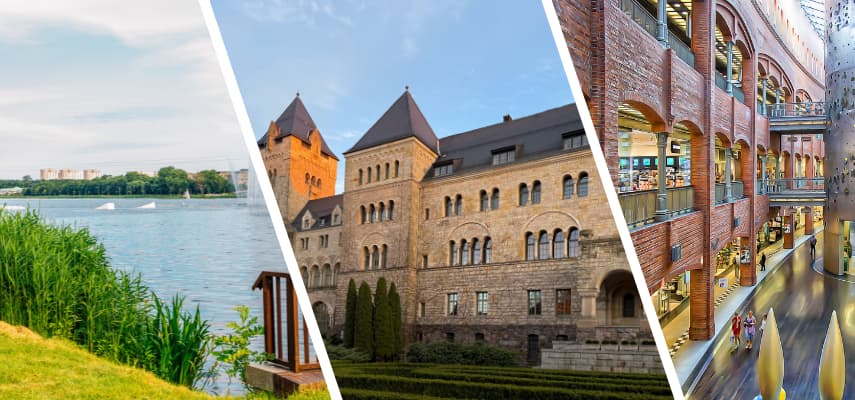
Outside Stary Rynek, Poznań’s main sights are within a half-hour walk or a short tram ride. Choose by interest rather than trying to see everything.
The Imperial Castle (Zamek Cesarski), on Święty Marcin street, was completed in 1910 as one of the last major imperial residences built in Europe. Today it operates as the Zamek Cultural Centre — concerts, exhibitions, the Animation Theatre, and a small art-house cinema (Kino Pałacowe). The basement houses the Poznań June 1956 Uprising Museum, which documents the first major workers’ protest against the communist regime in Poland. Just outside the castle is the Enigma Cipher Centre, opened in 2021 and dedicated to the three Poznań mathematicians — Marian Rejewski, Jerzy Różycki, and Henryk Zygalski — who first broke the Enigma cipher in 1932 and shared their breakthrough with French and British intelligence in 1939, work that fed directly into Bletchley Park during the Second World War. For visitors who know the Bletchley story, this is the Polish chapter that came first.
Stary Browar is a former brewery complex converted into a shopping and art centre in 2003 — one of the better-known adaptive-reuse projects in Polish urban architecture. The conversion combines restored nineteenth-century brick brewery buildings with modern glass extensions, and the project later won an International Council of Shopping Centres award for the world’s best medium-sized shopping centre. Worth thirty minutes for the architecture and the rotating contemporary art programme, more if you want to shop.
Malta Lake (Jezioro Maltańskie), about three kilometres east of the centre, is the city’s main recreation area and the venue for international rowing and canoeing competitions, plus a summer outdoor cinema and concert programme. Worth a visit in good weather, with children, or as a half-day break from museums; the narrow-gauge Maltanka park railway runs along the north shore to the New Zoo, set on a 116-hectare wooded site. Skip if your time is tight or the weather is poor.
The Museum of Musical Instruments, in three restored merchant houses on Stary Rynek, is the only museum of its kind in Poland and holds one of Europe’s largest collections of musical instruments. The collection numbers over 3,000 items, with around 500 to 600 on permanent display, covering European professional and folk traditions plus non-European instruments from across the world. The Chopin room — relics, manuscripts, period instruments — is the section music lovers will linger over. Visitors borrow a tablet at the entrance, in English, that plays recordings of selected instruments. Allow about an hour.
Football, the Poznań Wave, and Lech Poznań
If you watch English football, you have probably seen the Poznań Wave without knowing it had a name or a hometown. Fans turn their backs to the pitch, link arms with the people on either side, and jump in unison — a slow, rolling crowd movement that looks more like choreography than celebration. Manchester City fans have used it as their signature ritual since 2010. When Oasis fans revived it during the band’s 2025 reunion tour, Noel Gallagher thanked Lech Poznań publicly and called the craze one of the tour’s highlights.
The move comes from here. Lech Poznań supporters trace it back to the early 1960s, when fans used the gesture as a form of organised protest against the club’s management — facing away from the pitch while still showing up for the team. It stayed a Lech tradition for decades. On 21 October 2010, Lech played Manchester City at the Etihad Stadium in a Europa League group match. City won 3–1, but the night is remembered for the thousands of travelling Poznań fans who performed the move in the away end. City supporters adopted it immediately, called it “the Poznań”, and it has been a fixture of English football culture ever since.
Lech Poznań themselves are one of Poland’s most decorated clubs, founded on 19 March 1922 and based at the roughly 43,000-seat Stadion Poznań in the Grunwald district, about four kilometres south-west of the centre. The club has won the Polish top division ten times — most recently in the 2025–26 season — and regularly competes in European competitions. Tickets cost a fraction of equivalent Premier League prices and are sold through lechpoznan.pl; the atmosphere is loud and well-organised, suitable for older visitors who enjoy a strong sporting culture without the rougher edges of some European stadiums.
he club also runs official guided tours that include the mixed zone, visitors’ dressing room, players’ tunnel, substitutes’ bench, VIP boxes and press stand. Tours are bookable through the club website and run in English on request, on non-match days.
Day Trips from Poznań
If you have a third day, choose one excursion rather than collecting all three. Gniezno is the heritage choice, Kórnik the castle-and-library culture stop, and Wolsztyn the most unusual experience in the region. All three are reachable by public transport.
Gniezno — coronations, archbishops, and the other Piast origin story
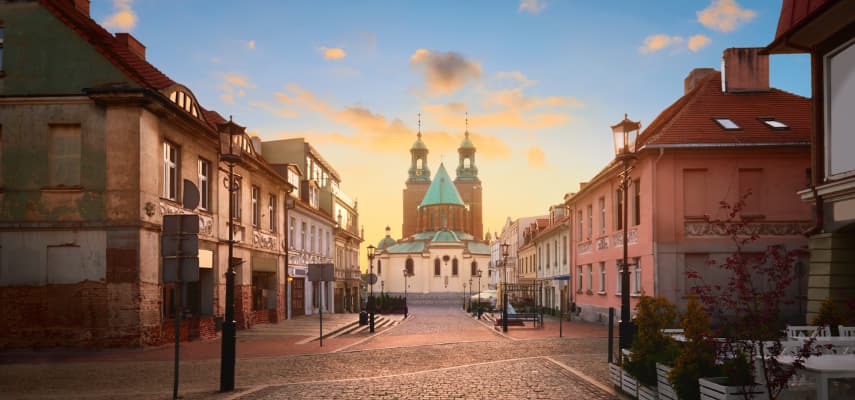
Gniezno, about 50 kilometres east of Poznań, became the seat of Poland’s first archbishopric in the year 1000 and was the site of the country’s first royal coronations, including Bolesław Chrobry’s in 1025. The Romanesque Bronze Door of Gniezno Cathedral, cast around 1175, is one of the finest examples of Romanesque metalwork in Central Europe — its eighteen panels narrate the life of St. Adalbert (Wojciech), the Bohemian missionary martyred in 997, whose remains rest in a silver reliquary inside the cathedral.
Getting there: Regional trains from Poznań Główny every 30–60 minutes; journey time about 40 minutes. Time needed: Half a day for the cathedral and old town; a full day if you also visit the Museum of the Origins of the Polish State.
Kórnik — a castle on a lake and one of Poland’s oldest libraries
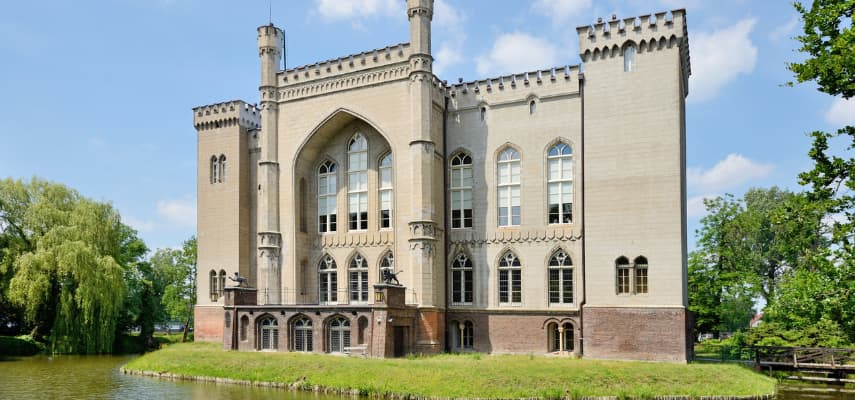
Kórnik Castle, 25 kilometres south of Poznań, was acquired by Tytus Działyński in 1826; the Kórnik Library he founded a few years later is now, since 1953, part of the Polish Academy of Sciences and holds around 400,000 volumes, including 14,000 manuscripts and a Romantic novella in Napoleon’s own hand. The castle’s interiors, restored in the nineteenth century in a Neo-Gothic style based on a design by Karl Friedrich Schinkel, are preserved as a period museum. Behind the castle, the Kórnik Arboretum — founded in 1830 — is one of the oldest and largest in Poland.
Getting there: Bus from the Poznań main bus station; about 50 minutes. Time needed: Three to four hours including the arboretum.
Wolsztyn — the last working steam locomotive depot in Europe
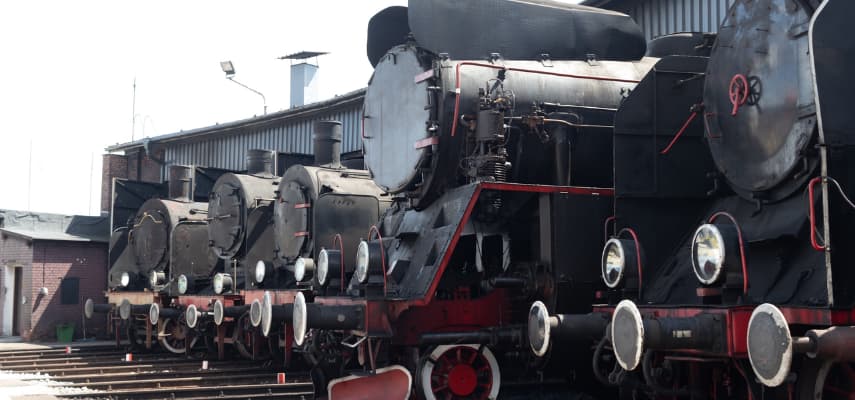
The Wolsztyn Steam Locomotive Depot (Parowozownia Wolsztyn), 80 kilometres south-west of Poznań, runs the last regularly scheduled passenger trains in Europe hauled by working steam locomotives. The depot has been operating since the early twentieth century, and the surviving fleet includes locomotives from classic Polish steam classes such as Pt47 and Ol49. As of the 2026 schedule, steam-hauled services run Monday to Friday between Wolsztyn and Zbąszynek, and on Saturdays between Wolsztyn and Poznań Główny, allowing visitors to make the round trip in a single day. There are no regular Sunday services.
The depot also runs a small museum, offers guided workshop tours, and hosts the annual Parade of Steam Locomotives on the first weekend of May — an event that draws several thousand railway enthusiasts from across Europe.
Getting there: Take the Saturday steam-hauled service from Poznań Główny direct to Wolsztyn (about 2.5 hours), or a regular train on weekdays. Schedules can change with locomotive availability — always check parowozowniawolsztyn.pl before travelling.
Time needed: A full day from Poznań.
Insider Tips
- Pair Ostrów Tumski with Śródka in the same morning. A short bridge connects them; most visitors miss Śródka entirely. The mural, the small market square, and the better lunch options on this side of the river make Śródka the natural extension of the cathedral island. Hyćka Restauracja, on the Śródka market square, is the most-recommended local lunch stop.
- The Poznań City Card pays off from day two onwards. Available in 24-, 48-, and 72-hour versions, the card gives free public transport, free entry to most municipal museums, and discounts of up to 40% at major paid attractions like the Enigma Cipher Centre and Brama Poznania. Buy it through the official mobile app or at any Tourist Information point. Current pricing and the full list of attractions are at visitpoznan.pl.
- For most visitors heading to the centre, bus 159 is the simplest airport transfer. It runs every 15–25 minutes from outside the arrivals terminal directly to Poznań Główny, the main train station. Buy a 45-minute ticket before boarding — PLN 7 as of the current 2026 tariff. App-based taxis (Bolt, Uber, FreeNow) are widely available; prices vary by time of day and demand. Line 148 also serves the airport, while night line 222 covers late-night connections.
- Several major museums close on Mondays or operate reduced hours. Plan museum-heavy days for Tuesday through Saturday, and check opening times before going. Sundays are usually open, with some free-entry slots.
- November 11 is the best and most crowded day to be in Poznań. Saint Martin’s Day combined with Polish Independence Day produces a city-wide festival. The programme changes year by year, but usually includes a parade down Święty Marcin street, outdoor events, and heavy demand for St. Martin’s croissants. Book accommodation at least two months in advance.
- Trains to Berlin make Poznań an easy stopover. The Berlin–Warsaw EC trains stop at Poznań Główny — three hours to Berlin Hauptbahnhof and two hours forty to Warszawa Centralna, with several direct departures daily. Check Deutsche Bahn or PKP Intercity for current times; booked in advance, fares run well below same-day prices.
Where to Stay
Most visitors stay either in the Old Town (Stare Miasto) for walking access to Stary Rynek, or near the train station for arrival convenience.
Old Town (Stare Miasto) — best for first-time visitors and short stays. Brovaria Boutique Hotel sits directly on Stary Rynek (Stary Rynek 73–74) with its own microbrewery and restaurant on the ground floor; rooms look onto the square. PURO Poznań Stare Miasto is a 135-room design hotel on Stawna 12, on the edge of the Old Town near the former Jewish quarter, with the in-house Nifty restaurant and a Michelin Guide hotel listing. As of May 2026, expect roughly $90–$170 per night for a mid-range three- or four-star property in this area.
Near Poznań Główny train station — useful for late arrivals or onward train travel. Sheraton Poznań is a four-star option a few minutes from the central rail station; Andersia Hotel & SPA, a member of Radisson Individuals, is a four-star high-rise next to Stary Browar. Mid-range three-stars in this area run roughly $70–$130 as of May 2026.
Where to Eat
The Michelin Guide currently lists sixteen restaurants in and around Poznań (as of the 2025 edition, published June 2025) — one starred, four with the Bib Gourmand designation, and eleven recommended. Regional Wielkopolska cooking is heavier than southern Polish food: duck, goose, and game; pyzy (potato or yeast dumplings) served with sauce or filled; sour rye soup (żurek); and the regional curiosity of czernina — a duck-blood and dried-fruit soup that visitors either embrace or remember.
What to order in Poznań: pyzy drożdżowe (large yeast dumplings, sweet or savoury); kaczka z modrą kapustą i kluskami (duck with red cabbage and dumplings); gęsina (goose, in autumn especially); szare kluski with bacon and onions; and a certified St. Martin’s croissant from any bakery showing the PGI sticker.
Fine dining and Michelin-recognised:
- Muga (Krysiewicza 5) — One Michelin Star (held three consecutive years), the only starred restaurant in Poznań. Tasting-menu format from chef Artur Skotarczak.
- Fromażeria (Poznańska 50) — Bib Gourmand. A specialist cheese bar with paired drinks and dishes built around cheese.
- SPOT. (Dolna Wilda 87) and TU.REStAURANT (Grunwaldzka 34A) — Both Bib Gourmand; modern European cooking with strong wine programmes.
- Posto (Kościelna 43) — Bib Gourmand 2025; French cooking in a renovated historic farmhouse in the Jeżyce district.
Traditional Wielkopolska cooking and Old Town classics:
- Bamberka (Stary Rynek 2) — Old Town tavern serving regional Wielkopolska dishes including pyzy, czernina, and roasted goose.
- Ratuszova (Stary Rynek 55) — Fine dining in a Renaissance tenement on the square, with modern interpretations of Polish and Central European cuisine.
- Brovaria (Stary Rynek 73/74) — The brewery-restaurant attached to the Brovaria hotel; regional Polish cooking with three beers brewed on site.
- Hyćka Restauracja (Śródka market square) — The recommended lunch stop when visiting Ostrów Tumski and Śródka, serving regional Wielkopolska dishes; duck preparations and local pierogi appear regularly on the menu.
Milk bars and casual:
- Bar Mleczny Jeżycki (Jeżyce district) — A working bar mleczny, the cafeteria-style Polish lunch format that remains one of the cheapest sit-down meals in the country.
For St. Martin’s croissants:
- Cukiernia Kandulski and Cukiernia Sowa — Both PGI-certified, multiple branches across the city.
As of May 2026, expect roughly PLN 80–150 for a mid-range Old Town meal without wine, PLN 20–35 in a milk bar, and PLN 10–20 for a certified St. Martin’s croissant depending on weight.
Frequently Asked Questions
What is Poznań best known for?
The Old Market Square and Town Hall with mechanical goats above the clock (at noon, and currently also at 3 PM); Ostrów Tumski, the cathedral island where Poland’s first Piast rulers are buried; the EU-protected St. Martin’s croissant; the Poznań International Fair; and Lech Poznań football, including the Poznań Wave celebration adopted by Manchester City fans.
How many days do I need in Poznań?
Two full days cover the centre at a relaxed pace — Stary Rynek and the Town Hall, Ostrów Tumski and the cathedral, the Croissant Museum, and one major museum. A third day allows for the Imperial Quarter (Enigma Cipher Centre, Zamek Cultural Centre) and Malta Lake. A fourth day opens up one of the regional day trips.
Is Poznań worth visiting if I’ve already seen Warsaw and Kraków?
Yes. Poznań is older than either as a political centre — it predates Kraków’s rise as the medieval capital. The concentration of founding-era history on Ostrów Tumski, the EU-protected food tradition, and a Michelin-rated restaurant scene give the city a character distinct from the better-known destinations. For travellers on a second or third trip to Poland, Poznań is the natural next stop.
Can you visit Poznań as a day trip from Berlin or Warsaw?
Possible but compressed. Direct EC trains run from Berlin Hauptbahnhof in about three hours and from Warszawa Centralna in about two hours forty, so a fast day trip is feasible. Realistically, an overnight stay is needed to see Stary Rynek, Ostrów Tumski, and the cathedral without rushing. From Berlin in particular, an overnight stop on a Warsaw-bound trip is the most efficient pairing.
When is the best time to visit Poznań?
Late April through early October for warm weather and outdoor cafés on Stary Rynek. The most distinctive time to visit is the week around November 11 for the St. Martin’s Day celebrations, though hotels fill quickly. Avoid late January and February — the city is cold and grey, and the outdoor life that gives Stary Rynek its character disappears.


User Comments (0)