
Discovering Gdansk, Sopot, and Gdynia: The Tricity Experience
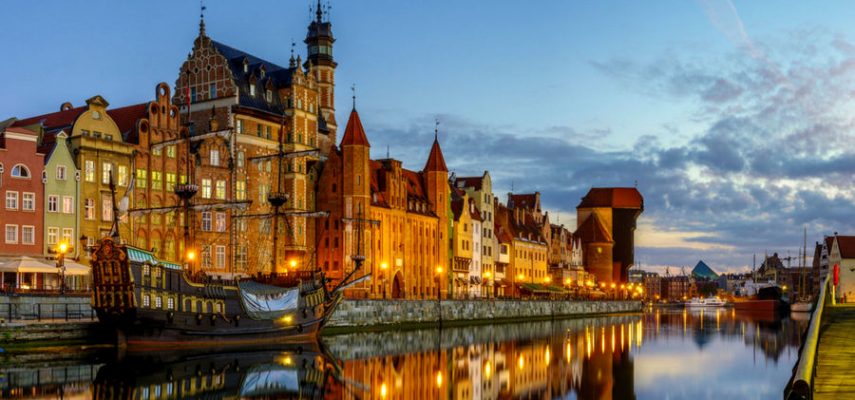
Three cities, one coastline, thirty minutes apart by train. Gdańsk, Sopot, and Gdynia — known collectively as the Tricity (Trójmiasto) — sit along Poland’s Baltic coast in a narrow corridor between the sea and the forested hills of the Tricity Landscape Park. Gdańsk brings a thousand years of Hanseatic history. Sopot is Poland’s most famous seaside resort. Gdynia, barely a century old, is the modernist newcomer with a working port and clifftop views. Together, they form one of Europe’s most varied urban coastlines — medieval, modernist, and seaside resort within a single commuter rail corridor — and one you can explore in as few as three days.
At a Glance
- Three cities, one transit system. The SKM commuter train connects Gdańsk, Sopot, and Gdynia every 10–15 minutes. Gdańsk to Sopot takes about 20 minutes; Gdańsk to Gdynia about 35 minutes.
- Minimum time needed: 3 full days — one per city. With 4–5 days you can add day trips (Malbork Castle, Hel Peninsula, Stutthof).
- Best base: Gdańsk for first-time visitors — the most accommodation options and the largest Old Town. Sopot if you prioritize beach access.
- Best time to visit: June and September. July–August brings peak crowds and prices (Polish school holidays). May and early October are cooler but uncrowded.
- Getting there: Gdańsk Lech Wałęsa Airport (GDN) has direct flights from most major European hubs. The PKM train connects the airport to Gdańsk Wrzeszcz and Gdynia in 25–40 minutes.
- Budget note: The Tricity is significantly cheaper than Western European coastal destinations. A full meal at a good restaurant runs 60–100 PLN (roughly €14–23). Museum tickets are typically 20–35 PLN.
Three Cities Compared
| Gdańsk | Sopot | Gdynia | |
|---|---|---|---|
| Character | Hanseatic Old Town, amber, WWII and Solidarity history | Beach resort, nightlife, elegant pre-war villas | Modernist port city, maritime heritage, cliffs |
| Best for | First-time visitors, history, museums, architecture | Beach time, summer nightlife, relaxed pace | Modernism fans, off-the-beaten-path, harbor walks |
| Must-see | St. Mary’s Basilica, European Solidarity Centre, Old Town waterfront | Sopot Pier, Monte Cassino Street, beach | Modernism Route, ORP Błyskawica, Orłowo Cliff |
| Time needed | 1.5–2 full days | 0.5–1 full day | 0.5–1 full day |
| Where to stay | Widest hotel range, best for hub-and-spoke | Best beach access, livelier nightlife | Quieter, more local feel, fewer tourists |
| Food scene | Diverse — touristy on the waterfront, better inland | Seafood, upscale dining, overpriced on Monciak | Growing local scene, least touristy |
Gdańsk: A Thousand Years in Brick and Amber
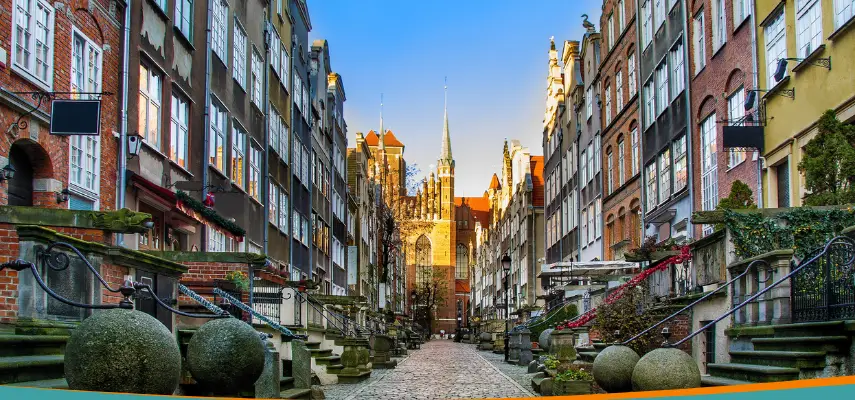
Gdańsk is where most visitors start, and where many wish they’d planned more time. The city was almost entirely destroyed in 1945 — about 90% of the center was reduced to rubble — and then painstakingly rebuilt from historical records and paintings. What you see today in the Old Town looks authentically medieval, but almost every brick was laid after World War II. That fact alone makes Gdańsk one of the most remarkable reconstruction stories in Europe.
The Old Town and Royal Route
The Royal Route runs from the Highland Gate through the Golden Gate, along Długa Street and Długi Targ (Long Market), to the Green Gate at the Motława River. This is the most photographed stretch of the city, and for good reason — the colorful merchant houses, rebuilt with obsessive attention to detail, give you a concentrated sample of what a prosperous Hanseatic trading city looked like.
Neptune’s Fountain stands at the center of Długi Targ, in front of the Artus Court. The bronze statue dates to 1612 and has become Gdańsk’s unofficial symbol. The local legend worth knowing: Neptune was furious that people kept throwing coins into his fountain, so he struck the water with his trident, shattering the gold into tiny flakes. That, according to the story, is how Goldwasser was born — Gdańsk’s signature herbal liqueur with real gold leaf, first produced in 1598. You can still buy a bottle at the Goldwasser restaurant on Długie Pobrzeże, housed in the original “Under the Salmon” building where the liqueur was invented.
Mariacka Street (ul. Mariacka), running from St. Mary’s to the waterfront, is the most photogenic street in the city — stone gargoyles on every building, amber shops at ground level, and a cobblestone surface with no cars. Visit in the early morning before the crowds. A guided walk through this area and the Old Town’s key landmarks typically takes about three hours — StayPoland’s Gdańsk City Walk covers this route.
St. Mary’s Basilica
This is the building that defines the Gdańsk skyline. Completed in 1502 after 159 years of construction, St. Mary’s is one of the largest brick churches in the world — 105.5 meters long, 66 meters wide at the transept, with a capacity for 25,000 people. The interior is deliberately austere: white walls, soaring Gothic vaults, and the light from 37 enormous windows. The medieval astronomical clock (1464) is nearly 14 meters tall and still displays the time, date, moon phases, and positions of the sun and moon against the zodiac.
Climb the 405 steps to the top of the 78-meter tower for the best panoramic view of the city and the Baltic coast. The stairway is narrow and steep — not recommended for anyone with mobility issues or claustrophobia — but the view from the top is the single best thing you can do in Gdańsk for orientation.
The Solidarity Story
The European Solidarity Centre (Europejskie Centrum Solidarności, or ECS) sits at the entrance to the Gdańsk Shipyard, where the Solidarity trade union was born in August 1980. The building itself, opened in 2014, is designed to resemble a rusting ship hull — a nod to the shipyard origins of the movement.
The permanent exhibition spans seven galleries. It traces the story from the strikes and the signing of the August Agreements, through martial law, to the fall of communism in 1989. It’s not just about Poland — the exhibition places Solidarity in the context of opposition movements across the entire Eastern Bloc. Audio guides (included in the ticket price, available in many languages) are essential here. Allow at least 2.5 hours.
Outside the ECS, the Monument to the Fallen Shipyard Workers of 1970 — three towering crosses — marks the spot where workers were killed by government forces during earlier protests. The entire area (ECS, Gate No. 2, the monument, and Plac Solidarności) received the European Heritage Label.
Practical: Open daily except Tuesdays. Check ecs.gda.pl for current hours and ticket prices, as they vary by season.
Oliwa: The Cathedral Detour
Most visitors skip Oliwa, which is a mistake. The Oliwa Cathedral (Archcathedral Basilica of the Holy Trinity) is within Gdańsk’s city limits, reachable by SKM train to Gdańsk Oliwa station (about 15 minutes from the center). The main draw is the 18th-century Rococo organ — one of the finest in Europe, with approximately 7,876 pipes, 110 registers, and a set of moving cherubs, trumpet-wielding angels, and rotating stars that activate during performances. Twenty-minute organ recitals run daily in summer, less frequently in the off-season (check archikatedraoliwa.pl for the current schedule and any entrance fee). Note: the main entrance closes at the start of each recital; arrive a few minutes early, or use the side entrance.
The surrounding Oliwa Park, laid out on the grounds of a former Cistercian monastery founded in 1186, is one of the quietest green spaces in the Tricity — and a welcome contrast to Gdańsk’s busy Old Town.
Westerplatte
The Battle of Westerplatte on September 1, 1939 was the opening engagement of World War II. A small Polish garrison held this peninsula against German naval and ground assault for seven days. Today, a tall monument marks the site, and the ruins of the guardhouse and barracks are still visible. It’s a somber, largely undeveloped site — no multimedia museum, just the landscape and the remains. Reachable by bus or by tourist boat from the Gdańsk waterfront (the boat ride itself is worth it for the harbor views).
Museum of the Second World War
Opened in 2017, this is one of the most significant WWII museums in Europe and one of Gdańsk’s major newer attractions. The permanent exhibition — largely underground, spanning over 6,000 square meters — tells the story of the war through the experiences of ordinary people across multiple countries, not just Poland. The approach is deliberately multinational: displays cover the civilian experience in occupied Europe, the Pacific theater, the Holocaust, and the aftermath. Allow at least 3 hours. The building itself, a dramatic angular structure of rusted Corten steel near the Motława River, has become a Gdańsk landmark in its own right.
Sopot: Poland’s Baltic Riviera
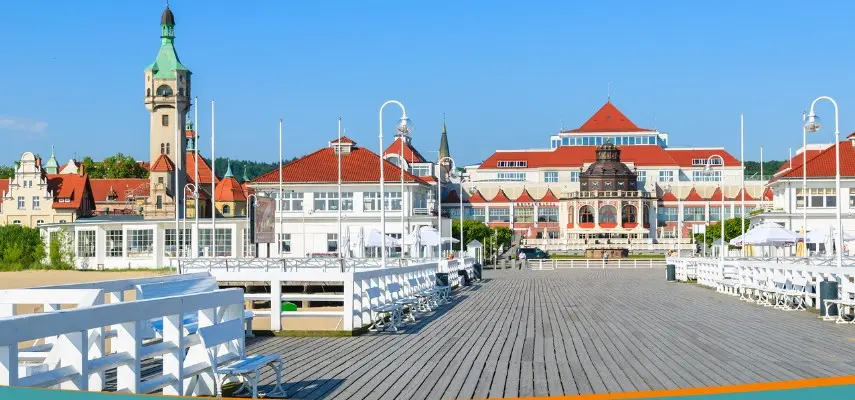
Sopot is physically small — about 40,000 residents — but its reputation as Poland’s premier seaside resort is outsized. The town has functioned as a spa destination since 1823, when French physician Jean Georges Haffner established the first bathing resort here. Today it’s a mix of elegant pre-war villas, beach bars, outdoor concerts, and a pedestrian main street that runs straight from the train station to the sea.
The Pier (Molo)
Sopot’s pier is the longest wooden pier in Europe at 511.5 meters, extending into the Bay of Gdańsk. First built in 1827 as a 31.5-meter jetty, it was extended to its current length in 1928. The walk to the end takes about 10 minutes, and the air at the tip of the pier reportedly contains twice the iodine concentration of the shoreline — a feature that originally attracted spa visitors for respiratory therapy.
At the seaward end, a modern marina accommodates yachts and smaller boats. In summer, water taxis and excursion boats depart from here. The pier charges a small entrance fee in peak season (roughly May–September); access is free the rest of the year.
Monte Cassino Street (Monciak)
Ulica Bohaterów Monte Cassino — locals call it Monciak — is Sopot’s pedestrian spine, running from the SKM station down to the pier. Restaurants, cafes, boutiques, and street performers line both sides. Midway down, you’ll pass the Krzywy Domek (Crooked House), a warped, Gaudí-esque building that’s become one of Sopot’s most photographed landmarks.
The street is livelier at night than during the day, especially in summer. If you want a quieter meal, turn off Monciak onto the side streets — the food is often better and the prices lower.
The Beach
Sopot’s beach stretches for 4.5 kilometers along the Baltic coast — wide, sandy, and well-maintained. The section directly adjacent to the pier is the most crowded. Walk north toward Gdynia-Orłowo or south toward Gdańsk-Jelitkowo for more space. The Baltic is cold by Mediterranean standards: water temperatures peak around 18–20°C in July and August. On a warm summer day, the beach is packed; on a quiet September afternoon, you might have a stretch of it to yourself.
Forest Opera (Opera Leśna)
Sopot’s open-air amphitheater sits in a wooded hollow about a 15-minute walk uphill from the center. It hosts major concerts and the Sopot International Song Festival — one of the oldest music festivals in Europe, running since 1961. The acoustics benefit from the natural bowl shape and the surrounding pine trees. Check the schedule before your visit; when nothing is programmed, the venue is closed to visitors.
Gdynia: The Modernist Port City
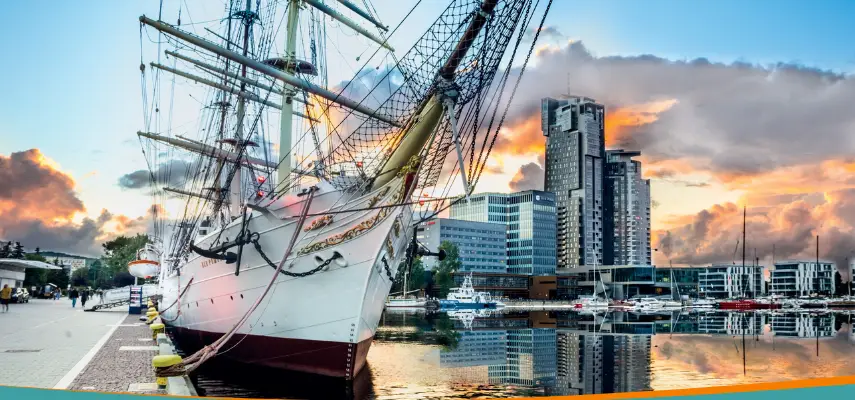
Gdynia is the youngest of the three cities and the one most visitors underestimate. In 1920 it was a fishing village of roughly a thousand inhabitants. Poland, newly independent and without a major port (Gdańsk was the Free City of Danzig, not fully under Polish control), built Gdynia from scratch into a modern commercial port. By 1939 it was one of the busiest ports on the Baltic.
That breakneck interwar construction left Gdynia with one of the best collections of modernist architecture in Poland — clean lines, rounded balconies, porthole windows, flat roofs. The city earned a spot on the European Route of Modernism.
Gdynia Modernism Route
Four walking routes thread through the city center, each showcasing interwar buildings from the 1920s and 1930s. The architecture is unmistakably influenced by the maritime setting — buildings with rounded corners that echo ship bows, porthole windows, and horizontal bands reminiscent of ocean liner decks. Key buildings include the PLO Transatlantic Shipping Company Office on 10 Lutego Street and several residential blocks along Świętojańska Street with their characteristic porthole windows and curved facades. Self-guided walks work fine, but a guided tour adds context about the architects and why the style is distinct from Gdańsk’s medieval aesthetic.
The Waterfront and Museum Ships
Gdynia’s harbor promenade (Nabrzeże Pomorskie / Skwer Kościuszki) runs along the working port. Two museum ships are moored here:
ORP Błyskawica — a 1930s Polish destroyer that served in World War II, including convoy protection in the Atlantic and the defense of the port of Cowes during German bombing. It’s the oldest preserved destroyer in the world and still officially part of the Polish Navy. The interior is a working museum of naval engineering and wartime history.
Dar Pomorza — a 1909 full-rigged sailing ship (the “White Frigate”), originally built in Hamburg as a German training vessel and purchased by Poland in 1929. She served the Maritime School in Gdynia for over 50 years, completing 102 training voyages and sailing half a million nautical miles before becoming a museum ship in 1983. You can walk the decks, see the officers’ quarters, and get a feel for what life at sea looked like on a pre-war tall ship.
Both ships are docked within walking distance of each other. Combined tickets are available.
Orłowo: Cliffs and a Quieter Pier
The Gdynia district of Orłowo, one stop south on the SKM, has a very different feel from the city center. The Orłowo Cliff (Klif Orłowski) is one of the most photographed natural features on the Polish coast — a steep, sandy bluff dropping directly to the beach, constantly reshaped by Baltic storms. Below, a wooden pier (shorter and quieter than Sopot’s) juts into the sea. The area is popular with locals and largely overlooked by tourists, making it ideal for a peaceful afternoon.
If you’d rather have a guide handle the logistics, StayPoland’s Full-Day Tricity Tour covers highlights across all three cities in about six hours — a practical option if your time is limited.
Getting Around the Tricity
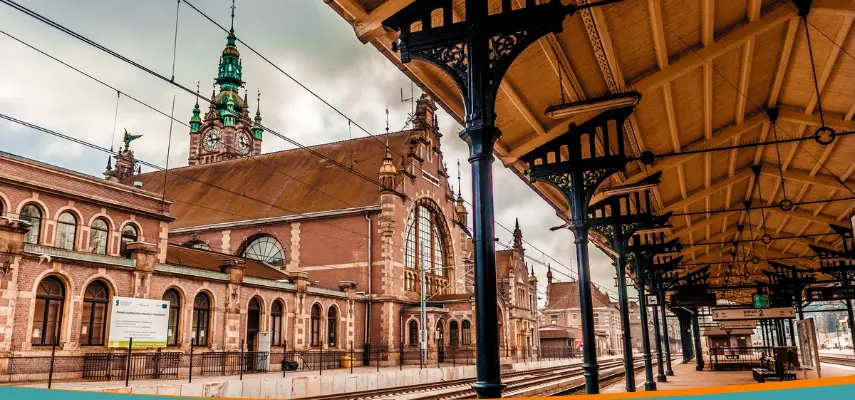
SKM: The Backbone
The SKM (Szybka Kolej Miejska — Fast Urban Railway) is the main way to move between the three cities. Trains run along the coast on dedicated tracks, with 27 stops between Gdańsk and Wejherowo (north of Gdynia). Key travel times from Gdańsk Główny (main station):
- To Sopot: ~20 minutes
- To Gdynia Główna: ~35 minutes
- Frequency: Every 10–15 minutes during the day; every 20–30 minutes in the evening and on weekends
Single tickets cost a few zloty per ride (price depends on distance — check skm.pkp.pl for the current fare table). Tickets can be purchased from machines on the platform (English interface available), via the KOLEO or Jakdojade mobile apps, or from the conductor on the train (with a small surcharge if a ticket machine was available at your station). Tickets bought from machines come pre-validated and are valid only for the next train.
Polregio trains also run the same route (sometimes faster) and accept the same ticket prices.
Tip: If you plan multiple trips in one day, check whether a 24-hour zone ticket (covering the Gdańsk–Gdynia corridor) saves money over individual tickets.
Other Options
Bus and tram: Gdańsk has an extensive tram and bus network. Sopot and Gdynia have bus and trolleybus services. The MZKZG metropolitan transport authority issues tickets valid across all three cities’ local transit systems as well as SKM.
Bicycle: The Tricity has a well-developed cycling path running along the coast, mostly separated from car traffic. MEVO (the metropolitan bike-sharing system) has stations across all three cities.
Uber/Bolt: Both operate in the Tricity. A ride from Gdańsk Old Town to Sopot pier costs roughly 30–50 PLN depending on traffic and demand.
Car: Unnecessary and often counterproductive within the Tricity. Parking in Gdańsk Old Town and Sopot center is limited and expensive in summer.
Where to Eat
The Tricity’s food scene has improved dramatically in recent years. A few specifics worth noting:
In Gdańsk: The waterfront along Długie Pobrzeże is scenic but touristy. For better quality at lower prices, walk a few streets inland. Try pyzy (potato dumplings specific to Gdańsk — larger and heavier than standard pierogi) alongside the usual Polish standards.
In Sopot: Monciak is convenient but overpriced for what you get. The side streets, especially toward the southern end of town, have smaller restaurants with more character. Seafood is the natural choice here — fresh Baltic herring, smoked fish from the fishing boats at the harbor in Gdynia-Orłowo.
In Gdynia: The area around Skwer Kościuszki and Świętojańska Street has a growing restaurant scene that tends to be more local and less tourist-oriented than Gdańsk’s Old Town.
Regional drinks to try: Goldwasser (described in the Gdańsk section above) and craft beers from local breweries — the Tricity has a growing microbrewery scene, particularly in Gdańsk’s Wrzeszcz district.
Common Mistakes
Skipping Gdynia. Many visitors treat the Tricity as “Gdańsk plus a day trip to Sopot” and miss Gdynia entirely. The modernist architecture, the Orłowo cliffs, and the harbor promenade are unlike anything in the other two cities.
Not enough time. One day for all three cities is a forced march. Two days is workable if you focus. Three full days — one per city — is the minimum to do it properly.
Staying only on the main streets. Gdańsk’s ul. Mariacka is justifiably famous, but the streets south of the main tourist route (toward Stare Przedmieście) are quieter and often more interesting. In Sopot, walking 10 minutes from Monciak in any direction changes the experience entirely.
Visiting in peak August without booking ahead. Sopot in particular fills up completely during Polish summer holidays. Hotel prices double. The beach is standing room only. June or September offers the same weather with half the crowd.
Ignoring Oliwa. The organ recital at Oliwa Cathedral takes about 20 minutes. It’s one of the best things you can do in the Tricity, and it’s just a few SKM stops from the center.
Day Trips from the Tricity
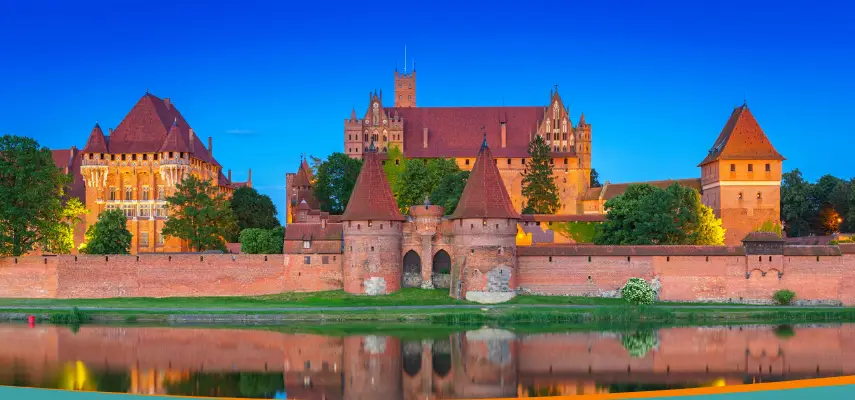
Malbork Castle — The largest brick castle in the world and a UNESCO World Heritage Site, built by the Teutonic Knights in the 13th century. About 1 hour south by train from Gdańsk Główny. A full visit takes 3–4 hours.
Hel Peninsula — A 35-kilometer sand spit stretching into the Baltic. Reachable by boat from Gdańsk/Sopot/Gdynia (seasonal) or by train/bus. The town of Hel at the tip has a seal sanctuary and some of the cleanest beaches in Poland.
Stutthof — The first Nazi concentration camp established outside German borders, located about 35 km east of Gdańsk. A sobering and important visit. Reachable by bus or car.
FAQ
How many days do I need for the Tricity?
Three full days is the practical minimum — one for each city. With four or five days, you can add a day trip to Malbork Castle or the Hel Peninsula and explore more neighborhoods at a slower pace.
Is the Tricity safe for tourists?
Yes. The Tricity is one of the safest urban areas in Poland. Standard city precautions apply — watch for pickpockets in crowded tourist areas in Gdańsk Old Town and on Sopot’s beach — but violent crime affecting tourists is extremely rare.
Which city should I use as a base?
Gdańsk for most visitors — the widest selection of hotels and restaurants, the biggest Old Town, and central SKM connections. Sopot is a good alternative if you want to be on the beach. Gdynia makes sense if you’re arriving by ferry from Scandinavia.
Can I use credit cards everywhere?
Almost everywhere. Poland has widely adopted cashless payments. Even small cafes and market stalls often accept cards and contactless payments (including Apple Pay and Google Pay). SKM ticket machines accept cards.
What language is spoken?
Polish. English is widely spoken in hotels, restaurants, and museums, especially in Gdańsk and Sopot. Younger Poles in particular tend to speak good English. Basic Polish phrases (dzień dobry, dziękuję, proszę) are appreciated but not essential.
Is the Baltic Sea warm enough for swimming?
In July and August, water temperatures reach 18–20°C — cool but swimmable. Many locals swim regularly. Outside of summer, the water is too cold for most swimmers. The beaches remain pleasant for walking year-round.
How do I get from the airport to the city?
Gdańsk Lech Wałęsa Airport is connected to the Tricity by the PKM train (to Gdańsk Wrzeszcz and onward to Gdynia, taking 25–40 minutes). Taxis and Uber/Bolt are also available; expect 40–60 PLN to central Gdańsk.
Do I need to rent a car?
No. The SKM train, city buses, trams, and ride-hailing apps cover everything you need within the Tricity. A car is useful only for day trips to less accessible destinations (some parts of Kashubia, smaller villages).
Last reviewed: April 2026. Prices, hours, and transport schedules change — verify details on official websites before your visit.


User Comments (0)