
UNESCO World Heritage Sites in Poland
Poland has seventeen UNESCO World Heritage Sites — fifteen cultural, two natural. Two of them (Kraków’s Old Town and the Wieliczka Salt Mine) were on the first World Heritage List ever published, in 1978. The latest addition, the primeval beech forests of the Bieszczady mountains, joined in 2021. This guide covers all seventeen: what they are, where they are, and which ones actually repay the detour.
At a Glance
- Poland has 17 UNESCO World Heritage Sites: 15 cultural and 2 natural.
- Two of Poland’s sites — Kraków’s Old Town and the Wieliczka Salt Mine — were on the first-ever UNESCO World Heritage List in 1978, alongside the Galápagos Islands and Yellowstone.
- Three sites are transnational, shared with Belarus (Białowieża Forest), Germany (Muskau Park), and Ukraine (Wooden Tserkvas of the Carpathian Region).
- The newest Polish inscription — forest components in Bieszczady National Park — joined in 2021 as part of the pan-European Ancient and Primeval Beech Forests property.
- Most of the major sites cluster around Kraków. Five UNESCO sites sit within two hours of the city. Others — Białowieża, Muskau Park, the Carpathian tserkvas, the Bieszczady beech forests — require dedicated detours.
- Auschwitz-Birkenau is inscribed under the full official name Auschwitz Birkenau German Nazi Concentration and Extermination Camp (1940–1945) — UNESCO uses that wording precisely to prevent the misleading label “Polish camp.”
- All seventeen in one trip is possible but punishing. A realistic cultural itinerary covers six to eight.
The Complete List: All 17 UNESCO Sites
| # | Site | Year inscribed | Location / region | Category |
|---|---|---|---|---|
| 1 | Historic Centre of Kraków | 1978 | Kraków (Lesser Poland) | Cultural |
| 2 | Wieliczka and Bochnia Royal Salt Mines | 1978, ext. 2013 | near Kraków (Lesser Poland) | Cultural |
| 3 | Auschwitz Birkenau German Nazi Concentration and Extermination Camp (1940–1945) | 1979 | Oświęcim (Lesser Poland) | Cultural |
| 4 | Białowieża Forest (with Belarus) | 1979, ext. 1992, 2014 | Podlasie / Poland–Belarus border | Natural |
| 5 | Historic Centre of Warsaw | 1980 | Warsaw | Cultural |
| 6 | Old City of Zamość | 1992 | Zamość (Lublin region) | Cultural |
| 7 | Medieval Town of Toruń | 1997 | Toruń (Kuyavia-Pomerania) | Cultural |
| 8 | Castle of the Teutonic Order in Malbork | 1997 | Malbork (Pomerania) | Cultural |
| 9 | Kalwaria Zebrzydowska Mannerist Architectural and Park Landscape Complex and Pilgrimage Park | 1999 | near Kraków (Lesser Poland) | Cultural |
| 10 | Churches of Peace in Jawor and Świdnica | 2001 | Lower Silesia | Cultural |
| 11 | Wooden Churches of Southern Małopolska | 2003 | Lesser Poland / Subcarpathia | Cultural |
| 12 | Muskau Park / Park Mużakowski (with Germany) | 2004 | Łęknica / Bad Muskau (Lubusz) | Cultural |
| 13 | Centennial Hall in Wrocław | 2006 | Wrocław (Lower Silesia) | Cultural |
| 14 | Wooden Tserkvas of the Carpathian Region (with Ukraine) | 2013 | Lesser Poland / Subcarpathia | Cultural |
| 15 | Tarnowskie Góry Lead-Silver-Zinc Mine and its Underground Water Management System | 2017 | Upper Silesia | Cultural |
| 16 | Krzemionki Prehistoric Striped Flint Mining Region | 2019 | near Ostrowiec Świętokrzyski (Holy Cross region) | Cultural |
| 17 | Ancient and Primeval Beech Forests of the Carpathians (Bieszczady components) | 2021 (Polish extension) | Bieszczady National Park (Subcarpathia) | Natural |
The Two 1978 Originals — Poland on the First UNESCO List
When UNESCO published its first World Heritage List in 1978, only twelve sites on earth made the cut. Two of them were in Poland.
Historic Centre of Kraków (1978)
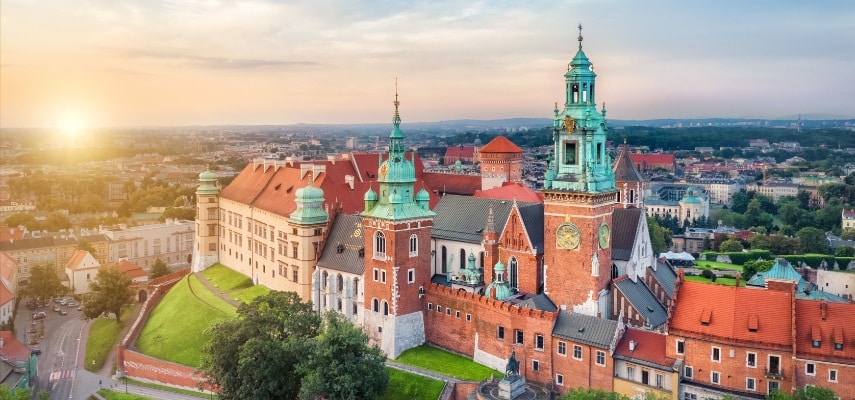
Kraków escaped the systematic destruction that flattened Warsaw and most other major Polish cities during the Second World War, which is why the Old Town still reads as authentically medieval — most of the stone, brick, and timber is original, not reconstructed.
The UNESCO inscription covers three connected zones — the walled Old Town around Rynek Główny, the Wawel hill with the royal castle and cathedral, and the Kazimierz district. Rynek Główny, laid out in 1257 after the Mongol invasion, measures roughly 200 by 200 meters and is one of the largest medieval market squares in Europe. The Cloth Hall (Sukiennice) in the middle has been a trading building since the 14th century and still is — it now sells amber, folk art, and souvenirs downstairs, with the National Museum’s 19th-century Polish painting collection upstairs. At the square’s eastern corner, St. Mary’s Basilica houses the Veit Stoss altarpiece, carved in limewood between 1477 and 1489. At 13 meters tall and 11 meters wide with the wings open, it is widely considered the largest Gothic altarpiece in the world. Every hour, the hejnał mariacki trumpet call sounds from the taller of the basilica’s two towers and breaks off mid-note, a tradition commemorating a medieval watchman killed during a Tatar raid.
Wawel Hill, a ten-minute walk south, holds the Royal Castle, the cathedral where most Polish kings are buried, and the Renaissance Sigismund Chapel (1519–33, designed by the Florentine architect Bartolomeo Berrecci) — often called the finest example of Italian Renaissance architecture north of the Alps. The gilded dome is visible from the cathedral courtyard.
Kazimierz, south of the Old Town, was a separate Jewish town from the 14th century until the Holocaust. Seven historic synagogues survive on and around Szeroka Street, including the 15th-century Old Synagogue (now a museum) and the still-active Remuh. The district served as a principal filming location for Spielberg’s Schindler’s List, though the actual wartime ghetto was across the river in Podgórze, where Oskar Schindler’s Enamel Factory now houses a substantial museum of the German occupation.
Wieliczka and Bochnia Royal Salt Mines (1978, extended 2013)
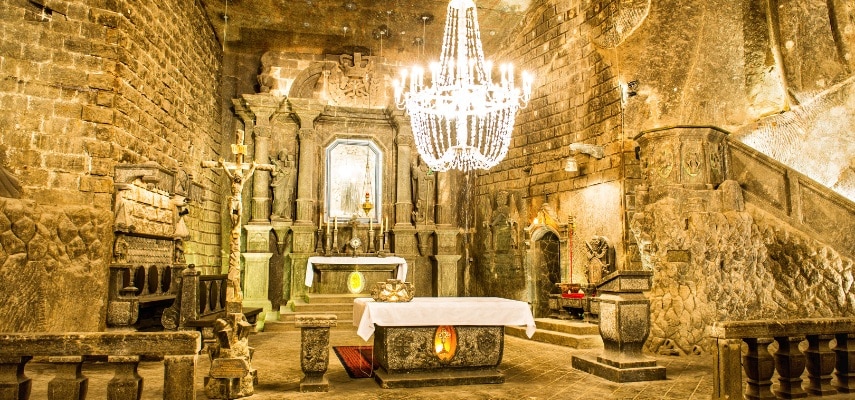
Wieliczka is the older and more famous of the two — a working rock-salt mine from the 13th century until commercial extraction stopped in 1996, after groundwater problems made it uneconomical to continue. That makes it one of the longest continuously operated industrial enterprises in European history.
The tourist route covers around three kilometers of galleries between 64 and 135 meters below the surface — a small fraction of the roughly 245 kilometers of passages that honeycomb the rock. The standout is St. Kinga’s Chapel, an underground church 54 meters long and 12 meters high, carved directly out of the rock salt by miners over several decades beginning in 1896. Everything is salt: the altar, the chandeliers, the floor, the reliefs copying da Vinci’s Last Supper and other Christian scenes. The acoustic is remarkable — concerts and weddings are held there regularly.
The Bochnia Salt Mine, about 40 km east of Wieliczka, is actually older (rock salt was extracted there from the mid-13th century, slightly earlier than at Wieliczka). It was added to the UNESCO inscription in 2013 along with the Saltworks Castle in Wieliczka, which housed the royal administration of the combined salt enterprise for seven centuries. Bochnia is quieter, less crowded, and offers an underground boat ride through a flooded chamber — a different experience from Wieliczka’s tour, not a substitute for it.
The Place of Memory
Auschwitz Birkenau German Nazi Concentration and Extermination Camp (1940–1945) — inscribed 1979
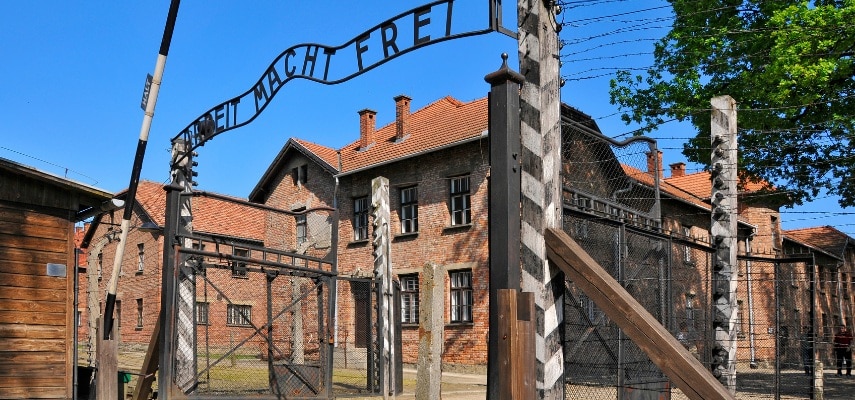
UNESCO uses the full official name of this site deliberately. The camps were built and operated by Nazi Germany on occupied Polish territory, and the wording in both the inscription and the museum’s signage — “German Nazi Concentration and Extermination Camp” — exists to prevent the careless shorthand “Polish camps,” which distorts the historical record.
The site, located in the town of Oświęcim (Auschwitz in German) about 70 km west of Kraków, consists of two surviving parts. Auschwitz I was the original camp, converted from a Polish army barracks in 1940 and used initially for Polish political prisoners. Its preserved brick blocks now house the permanent exhibitions, including the national exhibitions of many affected countries and the extensive display of personal effects seized from victims. Auschwitz II-Birkenau, three kilometers away, was built starting in 1941 on a much larger scale and became the principal site of mass murder in the Holocaust. The railway ramp where selections took place, the ruins of the gas chambers and crematoria, and the wooden barracks are preserved as a memorial.
Visits are managed by the Auschwitz-Birkenau State Museum. Admission to the grounds is free, but every visitor needs an Entry Pass reserved in advance through visit.auschwitz.org — the only official booking site. Between 10:00 and 15:00 from April through October, only guided-tour Entry Passes are accepted; outside those hours individual unguided passes are available subject to availability. Guided tours last around 3.5 hours and start at Auschwitz I. Allow at least four hours for a thorough self-guided visit; a full study visit takes most of the day. The Museum does not recommend the visit for children under 14. Photography is permitted in most areas but not in the hair exhibit (Block 4) or the basement of Block 11.
Most travelers come from Kraków. StayPoland offers private guided trips to Auschwitz — details and dates here.
Cities and Old Towns
Historic Centre of Warsaw (1980)
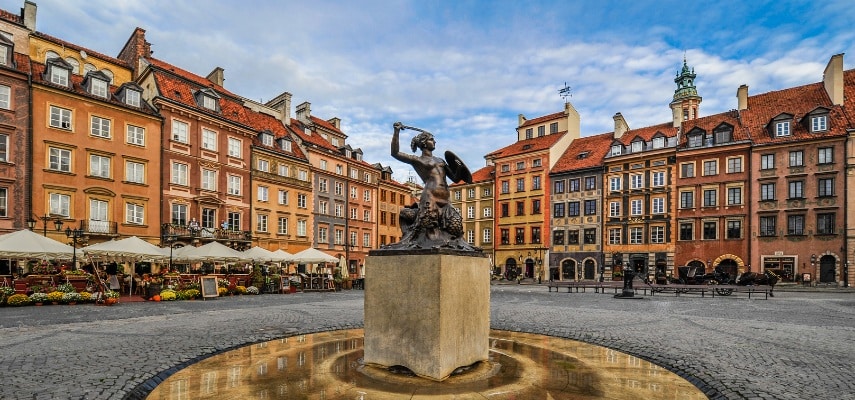
The Warsaw Old Town is the only urban complex on the UNESCO list that was almost entirely destroyed and then rebuilt. After the 1944 Warsaw Uprising, German forces systematically razed roughly 85 percent of the historic city center — block by block, on Hitler’s direct order, even after the uprising had ended. The reconstruction that followed, carried out between 1949 and 1963, drew on surviving 18th-century paintings by Bernardo Bellotto (Canaletto), architectural surveys drawn up by students of Warsaw Polytechnic in the 1930s, and salvaged original fragments to rebuild the Old Town and Royal Castle in their pre-war form. UNESCO listed it in 1980 not in spite of the reconstruction but because of it — as an exceptional example of post-war urban restoration driven by collective memory.
The inscribed area covers the Old Town (Stare Miasto) and the New Town (Nowe Miasto) north of it. The Royal Castle anchors the southern edge; the Market Square (Rynek Starego Miasta), with its reconstructed burghers’ townhouses, the Mermaid statue in the center, and the surrounding restaurants, is the classic postcard. A climb up the tower of St. Anne’s Church on Castle Square offers the best overview of how convincingly the reconstruction worked.
The rebuilt Old Town is not all of Warsaw by any means — the city has excellent modern museums, the preserved inter-war Praga district across the river, and a strong food scene — but the UNESCO site specifically refers to the reconstructed core.
Old City of Zamość (1992)
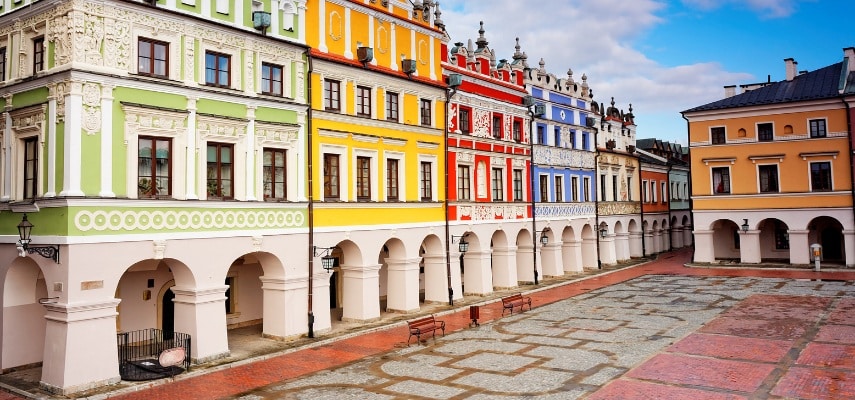
Zamość is the most ambitious Renaissance town-planning exercise ever completed in Poland. Chancellor Jan Zamoyski, one of the wealthiest and most politically powerful men in 16th-century Europe, commissioned the Paduan architect Bernardo Morando to design an entire fortified town from scratch, beginning in 1580. Morando laid it out according to the principles of the “ideal town” then fashionable in Italian architectural theory: an orthogonal grid, a Great Market Square with a monumental Town Hall at one end, a formal palace axis, and perfect geometric fortifications with seven bastions wrapping the whole.
Most of it survives. The Great Market Square (Rynek Wielki), exactly 100 × 100 meters, is lined with arcaded Armenian merchants’ houses decorated in Oriental-influenced stucco; the Town Hall with its fan-shaped stairway and Mannerist tower closes the north side. Surviving stretches of the Renaissance fortifications and several bastions can be walked. The small but excellent Zamość Synagogue, one of the finest in Poland, reflects the town’s original multicultural composition — Polish, Armenian, Sephardic Jewish, Italian, and Greek communities all lived within the walls.
Zamość sits well off the standard tourist routes, about three hours by road from Warsaw or Kraków, in the southeastern Lublin region. Its isolation is why it’s still intact.
Medieval Town of Toruń (1997)
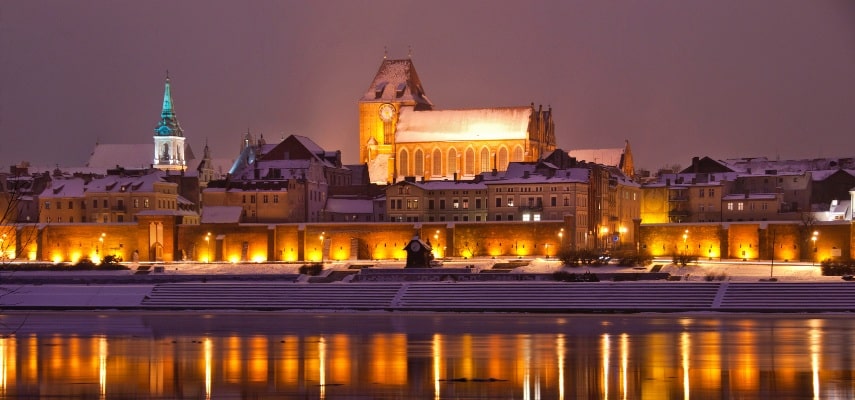
Toruń was founded by the Teutonic Order in 1231 and grew rich as a Hanseatic port on the Vistula. It escaped both the Swedish Deluge of the 17th century and the Second World War with its medieval street plan and most of its Gothic architecture intact — a rarity in Poland. The UNESCO inscription covers the Old Town, the New Town (established in 1264, east of the Old Town and later absorbed into the city), and the ruined Teutonic castle between them.
The Old Town Hall, dating from the late 13th century, is one of the most complete medieval town halls in Central Europe and now houses the district museum. The 40-meter tower can be climbed for views across the Old Town rooftops and the river. Toruń is also the birthplace of Nicolaus Copernicus (1473) — the house on ul. Kopernika is now a museum — and the origin of Polish gingerbread (piernik), documented since at least the 14th century. The Museum of Toruń Gingerbread on ul. Strumykowa includes a working historical bakery where visitors bake their own piernik from a 16th-century recipe.
Castles and Defensive Architecture
Castle of the Teutonic Order in Malbork (1997)
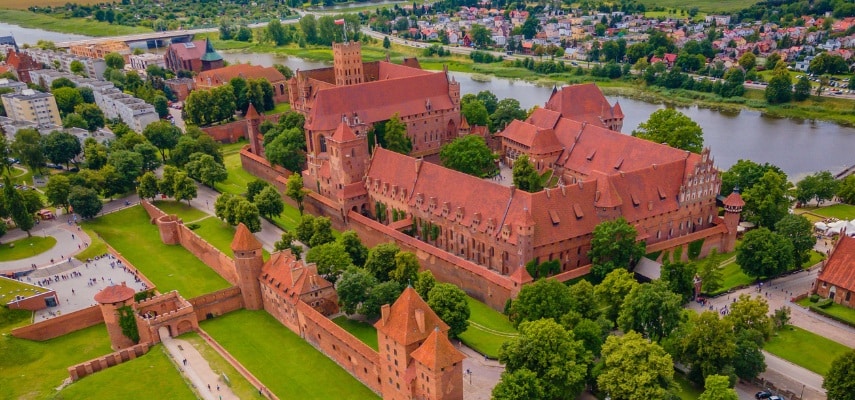
Malbork is the largest castle in the world by land area — 21 hectares of brick fortification on the east bank of the River Nogat — and the largest brick castle anywhere. Construction began in 1274 and continued, on and off, until around 1406. The Teutonic Knights made it their headquarters in 1309, when the Grand Master’s seat was transferred here from Venice, and ran their monastic state of Prussia from it for the next century and a half.
The complex has three connected sections built in stages. The High Castle is the oldest, a square four-winged convent enclosing a cloistered courtyard, with the restored castle church of the Blessed Virgin Mary at its east end (the restoration was completed in 2016, after the church was largely destroyed in 1945). The Middle Castle is where the Grand Master held court — its Great Refectory, with palm-vaulted ceilings supported on three slender granite columns, is the showpiece of secular Gothic interior architecture in Poland. The Outer Bailey, also known as the Lower Castle, contained the Karwan armory, workshops, stables, and a brewery.
The castle also holds one of the world’s leading collections of amber, reflecting the Teutonic Order’s historical monopoly on Baltic amber trade.
Malbork is about 50 minutes from Gdańsk by PKP Intercity train — arguably the easiest UNESCO site to reach by public transport in Poland. StayPoland runs a guided day trip from Gdańsk.
Wooden Sacred Architecture
Four separate inscriptions protect timber-built churches and chapels across southern Poland. Together they form one of the richest concentrations of wooden religious architecture in Europe.
Kalwaria Zebrzydowska Mannerist Architectural and Park Landscape Complex and Pilgrimage Park (1999)
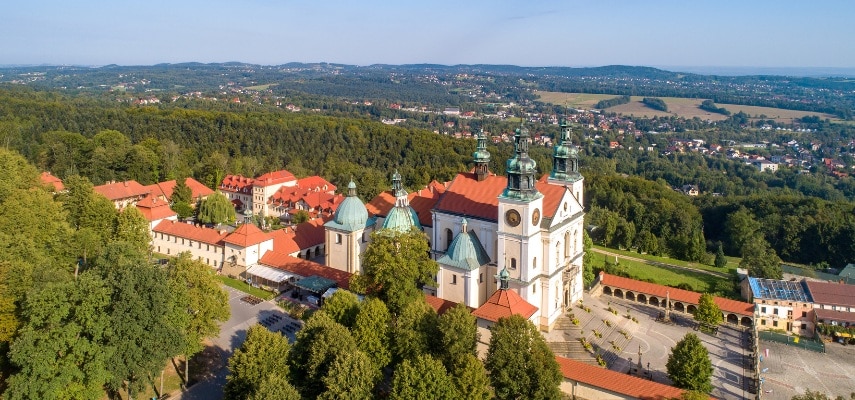
Kalwaria Zebrzydowska is a pilgrimage landscape rather than a single building. Laid out in the early 17th century by magnate Mikołaj Zebrzydowski, it reproduces the topography of Jerusalem — with the Basilica of Our Lady of the Angels and the Bernardine monastery standing in for sites associated with the Passion — using more than forty Mannerist and Baroque chapels distributed across wooded hills along the Skawinka stream. The Holy Week Mystery Plays, still staged annually with actors and crowds moving between chapels, have been running since the 17th century.
The site sits about 35 km southwest of Kraków and is most often visited as a half-day trip. It was a favorite devotional destination of Pope John Paul II, who grew up in nearby Wadowice.
Churches of Peace in Jawor and Świdnica (2001)
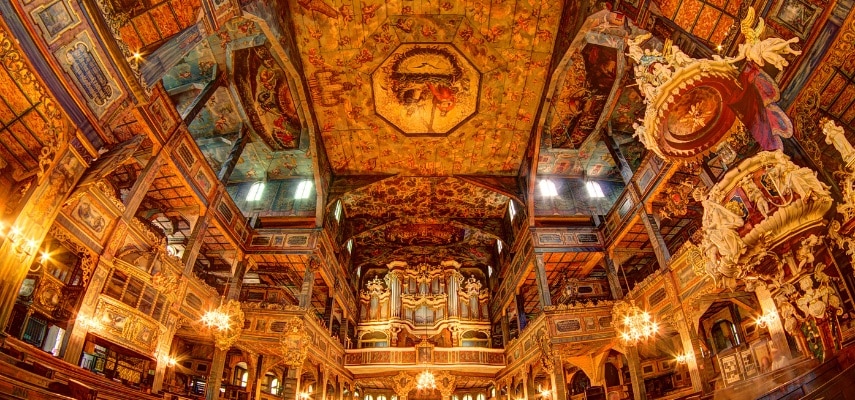
The two Churches of Peace in Lower Silesia are structural oddities, and the oddity is the whole point. After the 1648 Peace of Westphalia, the Catholic Habsburg emperor allowed Protestant communities in Silesia to build three churches — but only out of wood and clay, no stone or masonry; only outside town walls; with no towers or bells; and only in a year. The combination of constraints forced a remarkable act of structural improvisation.
The surviving two churches — at Świdnica (completed in 1657, with galleries seating around 7,500) and Jawor (completed in 1655, seating around 5,500) — are the largest timber-framed religious buildings in Europe. The restrained half-timbered exteriors conceal Baroque interiors of tiered galleries, painted ceilings, and organs that still hold summer concerts.
Wooden Churches of Southern Małopolska: Binarowa, Blizne, Dębno, Haczow, Lipnica Murowana, and Sękowa (2003)
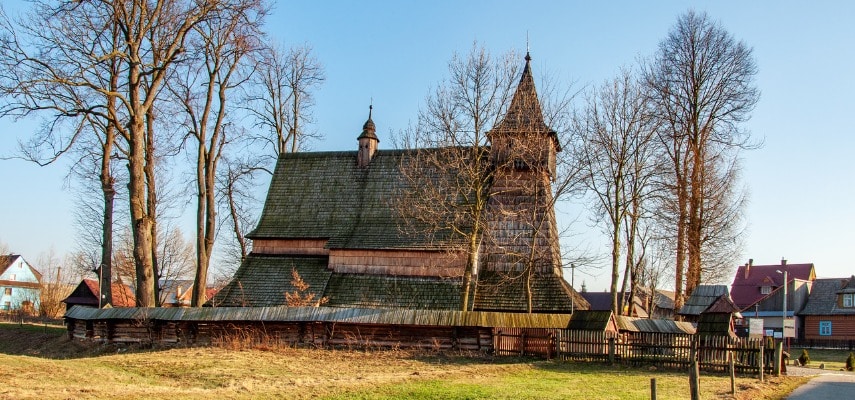
Six village churches scattered across the foothills of the Carpathians, built between the late 15th and 17th centuries by local carpenters without drawings, using the log construction technique typical of the region. Walls were built from horizontal logs joined at the corners without metal nails. The interiors are entirely painted — the crucifixion group at Dębno and the New Testament cycle at Binarowa are the set pieces, but all six have painted polychrome ceilings and walls covered in biblical scenes.
The sites are dispersed across southern Lesser Poland and Subcarpathia and can be combined with visits to nearby spa towns and the wooden tserkvas listed below. None are on a standard tourist route.
Wooden Tserkvas of the Carpathian Region in Poland and Ukraine (2013)
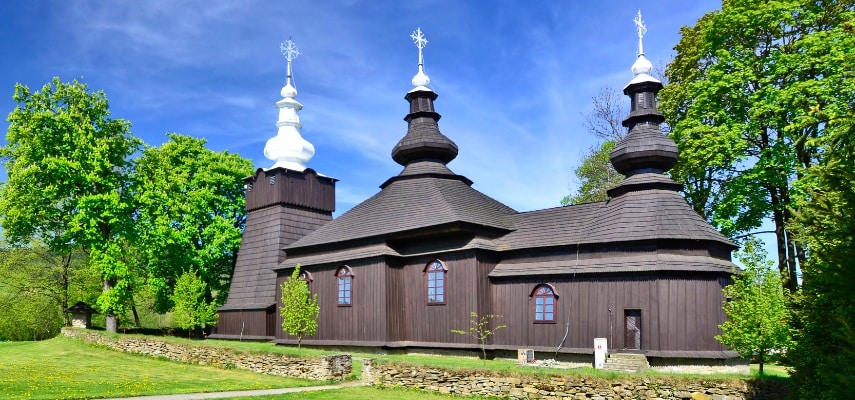
Sixteen Orthodox and Greek Catholic wooden churches, eight on each side of the border, built between the 16th and 19th centuries. They represent the timber-building tradition of the Carpathian mountain region — a distinct architectural culture from the Roman Catholic wooden churches listed above. The Polish eight are: Brunary, Chotyniec, Kwiatoń, Owczary, Powroźnik, Radruż, Smolnik, and Turzańsk. Most have the characteristic tripartite plan — sanctuary, nave, and women’s gallery, each with its own tower or onion dome — and interiors dominated by painted wooden iconostases.
These are deep-rural sites. Visiting more than one or two requires a dedicated trip through the quietest parts of southeastern Poland.
Landscapes and Industrial Heritage
Muskau Park / Park Mużakowski (2004)
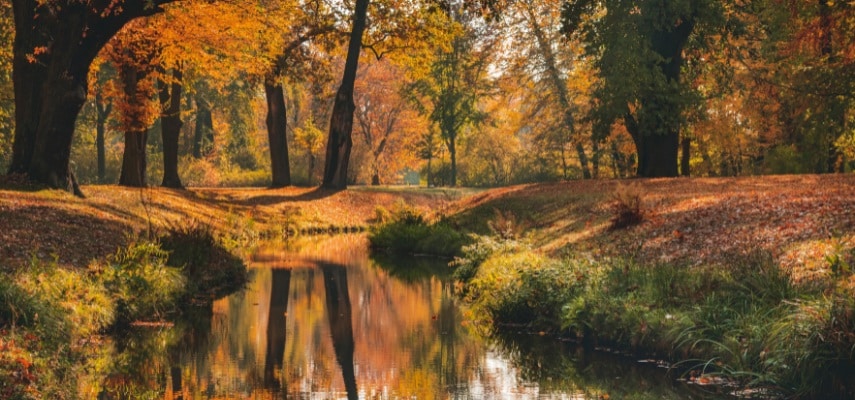
A 560-hectare English landscape park straddling the Lusatian Neisse river and thus the Polish–German border. It was designed in the 1810s–1840s by Prince Hermann von Pückler-Muskau on his family’s estate at Bad Muskau. Pückler was a pioneer of what he called “landscape painting with nature” — vistas composed between foreground trees, middle-ground water, and background buildings, arranged to look accidental. Two footbridges, the Double Bridge and the English Bridge, connect the Polish side (now the village of Łęknica) with the German side.
The Polish part of the park is freely accessible and rewards a long walk. The Pückler castle itself, on the German side, has been rebuilt and houses a museum dedicated to the prince.
Centennial Hall in Wrocław (2006)
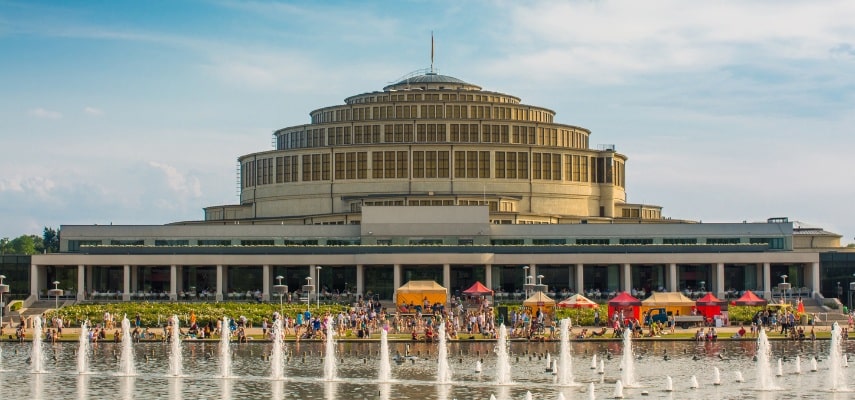
Built in 1911–1913 by the Wrocław city architect Max Berg, the Centennial Hall (Hala Stulecia, Jahrhunderthalle) was at the time the largest reinforced-concrete dome in the world — the 65-meter span exceeded that of the Pantheon in Rome, completed 18 centuries earlier. It marked the centennial of the 1813 Battle of Leipzig against Napoleon, and was used for exhibitions, concerts, and political rallies.
The engineering is the monument. The quatrefoil plan seats around 6,000, covered by a ribbed dome of concrete arches springing from a thin compression ring — a solution that influenced every subsequent large-span concrete structure, from Nervi’s arenas to airport terminals. It still functions as a concert and sports hall; the interior can normally be visited outside events. The surrounding exhibition grounds, laid out by Hans Poelzig, include the Four Domes Pavilion (now the Museum of Contemporary Art), a large Japanese Garden, and the Pergola with its multimedia fountain.
Lead-Silver-Zinc Mine in Tarnowskie Góry and its Underground Water Management System (2017)
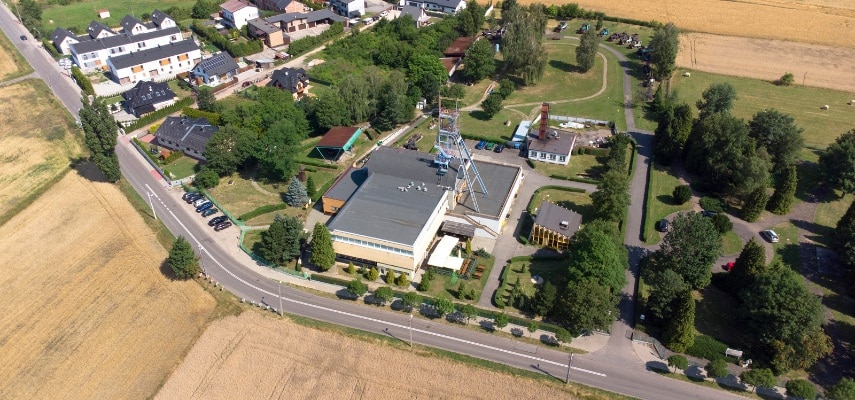
The Tarnowskie Góry mining complex in Upper Silesia operated from the 16th to the early 20th century, producing lead, silver, and later zinc for central Europe’s metal industry. What makes it UNESCO-worthy is not the ore itself but the underground water-management system miners developed to keep the workings dry — a network of drainage adits, pumping stations, and distribution channels that eventually supplied drinking water to the surrounding industrial towns.
The Black Trout Adit — a 600-meter stretch of the underground drainage canal, accessible by boat — is the most unusual part of the tourist route. The Historic Silver Mine gives a conventional underground walking tour through 1.7 km of galleries. Both sit a short drive north of Katowice.
Krzemionki Prehistoric Striped Flint Mining Region (2019)
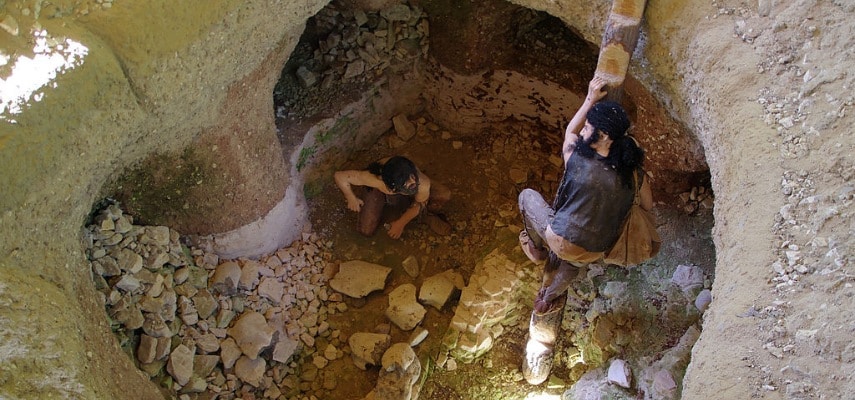
Photo: Jakub Hałun, CC BY-SA 4.0, via Wikimedia Commons
One of the best-preserved prehistoric mining landscapes anywhere. Between roughly 3900 and 1600 BCE, Neolithic and early Bronze Age communities dug hundreds of shafts into a limestone ridge near Ostrowiec Świętokrzyski, extracting the distinctive banded flint used for axes traded across central Europe. The UNESCO inscription protects four separate mining fields: Krzemionki, Borownia, Korycizna, and the Velikaia Gora region — roughly 400 hectares in total.
The tourist route descends into an original 5-meter-deep shaft and follows preserved Neolithic galleries. A reconstructed prehistoric village on the surface includes workshops and a megalithic tomb.
Nature and Primeval Forests
Białowieża Forest (1979, extended 1992 and 2014 — shared with Belarus)

The Białowieża Forest straddles the Polish–Belarusian border in Podlasie and is the last large fragment of the primeval broadleaf and mixed forest that once covered most of the European lowland. Continuous strict protection since 1921 (the Polish side became a reserve that year and a national park in 1932) has preserved extensive areas of old-growth forest where natural processes run uninterrupted — fallen trees rotting on the forest floor, uneven-aged stands, and a mycological and invertebrate diversity that has disappeared almost everywhere else.
It is also the stronghold of the European bison. The species was hunted to extinction in the wild by the early 1920s, then reintroduced into Białowieża from captive herds starting in 1952. The UNESCO property today supports approximately 900 free-ranging bison across the whole Polish–Belarusian site — the world’s largest free-living population.
Access to the strictly protected core zone is limited and requires a licensed guide. Guided walks, horse-cart rides, and early-morning bison-spotting tours can be arranged through the national park office in the village of Białowieża. StayPoland also runs small-group trips to the forest. The village is roughly four hours east of Warsaw by road; there is no convenient train connection.
Ancient and Primeval Beech Forests of the Carpathians (2021 — Polish extension)

Poland joined this transnational UNESCO property in 2021, when the World Heritage Committee approved a boundary extension adding beech forest components from eighteen countries. The four Polish components lie inside Bieszczady National Park in the remote southeastern corner of the country, covering roughly 3,500 hectares of old-growth beech stands in the strict reserve — on the slopes of the Wetlina Mountain Pasture and Mount Smerek, in the Border Range, and in the upper valleys of the Terebowiec, Wołosatka, and Solinka rivers.
These forests survived because the region was depopulated after the Second World War, when the post-war border adjustments and the forced resettlement of local populations removed human pressure almost entirely. They were never commercially managed. Today they are among the most remote and least-trafficked UNESCO components in Europe — access is via marked national park trails, and the actual inscribed reserve areas are off-limits to visitors, though the park itself is open and the surrounding beech woodland is effectively identical.
Bieszczady is at least seven hours from Kraków by road. The visit repays the effort mostly for people who want mountain hiking in very quiet country; it’s not a conventional sightseeing destination.
Planning Your UNESCO Trail — Realistic Itineraries
Trying to tick off all seventeen sites is possible but unrewarding — the remote components (Bieszczady beech forests, the tserkvas, Krzemionki) would eat most of the time and contribute the least value per day. A few realistic framings:
A Kraków base covers five sites comfortably. From Kraków, within two hours’ drive: the Old Town itself, Wieliczka and Bochnia, Auschwitz-Birkenau, Kalwaria Zebrzydowska, and several of the Wooden Churches of Southern Małopolska. Five days, five UNESCO sites, no long transfers.
A Warsaw–Gdańsk–Toruń loop covers three more. Warsaw’s Old Town, then Toruń on the way to the Baltic, then Malbork from Gdańsk. Add Białowieża if you have four extra days and real interest in old-growth forest.
Wrocław gives access to two, with a third in range. Centennial Hall is in the city. The Churches of Peace in Świdnica and Jawor are a short drive south. Muskau Park is three hours west — stretch, but feasible.
Industrial heritage detours (Tarnowskie Góry, Krzemionki) are best combined with other trips in the region rather than pursued on their own account. They’re genuinely interesting on arrival but require specific interest in mining or archaeology.
Transnational sites are worth crossing borders for only if you were already heading that way. The tserkvas extend into Ukraine; Muskau Park extends into Germany; Białowieża extends into Belarus (the Belarusian side is separately accessible via a visa-free travel zone).
Insider Tips
A handful of practical notes for visitors heading to the main sites:
- Entry to the Wawel Royal Castle is timed and ticketed separately for each exhibition. A single combined ticket doesn’t exist. Book the State Rooms, Royal Private Apartments, and the Crown Treasury and Armoury on wawel.krakow.pl in advance, especially on weekends. The cathedral has its own separate ticket, sold on site.
- Auschwitz-Birkenau requires an Entry Pass booked through visit.auschwitz.org regardless of when you come. Between 10:00 and 15:00 from April through October, only guided-tour passes are issued; outside those hours you can use an individual pass to visit without a guide. Plan on at least four hours and take the free shuttle bus between Auschwitz I and Birkenau. It runs every 10–15 minutes through most of the day.
- Wieliczka caps entries at specific hourly slots. Tickets booked on wieliczka-saltmine.com at least a few days ahead cost the same as the ticket window and avoid a long queue. Bring a light jacket — the temperature underground is a steady 14–16 °C year-round regardless of the surface weather.
- Malbork Castle lights up in the late afternoon. The red brick glows from across the Nogat in the hour before sunset, which is the classic photograph. Entry is timed; book online at zamek.malbork.pl.
- The Centennial Hall is sometimes closed to visitors when a concert or trade fair is being set up. Check the event calendar on halastulecia.pl before making a dedicated trip.
- Białowieża’s bison are most easily seen from November to March, when they come out of the deep forest to feed at supplementary feeding sites. Summer sightings are possible but much harder. The national park runs early-morning tours designed around bison observation.
- Zamość and Toruń have few direct rail connections from Warsaw and Kraków respectively. Driving or taking a bus via the regional capital is usually faster than the train.
- UNESCO Site Passes don’t exist in Poland. There is no combined ticket covering multiple sites. Budget individual admission (typically PLN 20–90 per site) and book anything popular online.
Frequently Asked Questions
How many UNESCO World Heritage Sites are there in Poland?
Seventeen, as of the 2021 extension that added Bieszczady’s beech forests to the pan-European Ancient and Primeval Beech Forests property. Fifteen are cultural and two are natural.
Which is the most visited UNESCO site in Poland?
Wieliczka Salt Mine and Auschwitz-Birkenau are the two most visited, each drawing well over a million visitors a year. Both are easy day trips from Kraków.
Can you visit all UNESCO sites in Poland in one trip?
Physically, yes, in about three weeks of focused travel with a car. Practically, the remote components (Bieszczady, the Carpathian tserkvas, Krzemionki) deliver much less value than the major urban and industrial sites. Most visitors cover five to eight UNESCO sites on a standard two-week Poland itinerary.
Which UNESCO site in Poland is best for a first visit?
Kraków’s Old Town is the obvious answer — it covers the most ground in the shortest distance (Old Town, Wawel, Kazimierz all within walking distance) and allows easy day trips to Wieliczka, Auschwitz, and Kalwaria Zebrzydowska.
Are any of Poland’s UNESCO sites endangered?
Białowieża Forest has been under repeated scrutiny from the World Heritage Committee, most notably during a 2017 logging dispute involving the Polish government and the European Court of Justice. No Polish site is currently on the List of World Heritage in Danger.
Is Auschwitz-Birkenau really called a “UNESCO site”?
Yes — it was inscribed in 1979 under the full official name Auschwitz Birkenau German Nazi Concentration and Extermination Camp (1940–1945). The inscription commemorates the site as a memorial and a warning, not as a conventional cultural attraction.
Which Polish UNESCO sites are transnational?
Three: Białowieża Forest (shared with Belarus), Muskau Park (shared with Germany), and the Wooden Tserkvas of the Carpathian Region (shared with Ukraine). The Ancient and Primeval Beech Forests property is also transnational, with components in eighteen countries.
When were Polish UNESCO sites inscribed?
Kraków and Wieliczka in 1978 (the first UNESCO list ever published); Auschwitz-Birkenau and Białowieża in 1979; Warsaw in 1980; and then at irregular intervals up to the Bieszczady beech forests in 2021.


User Comments (0)